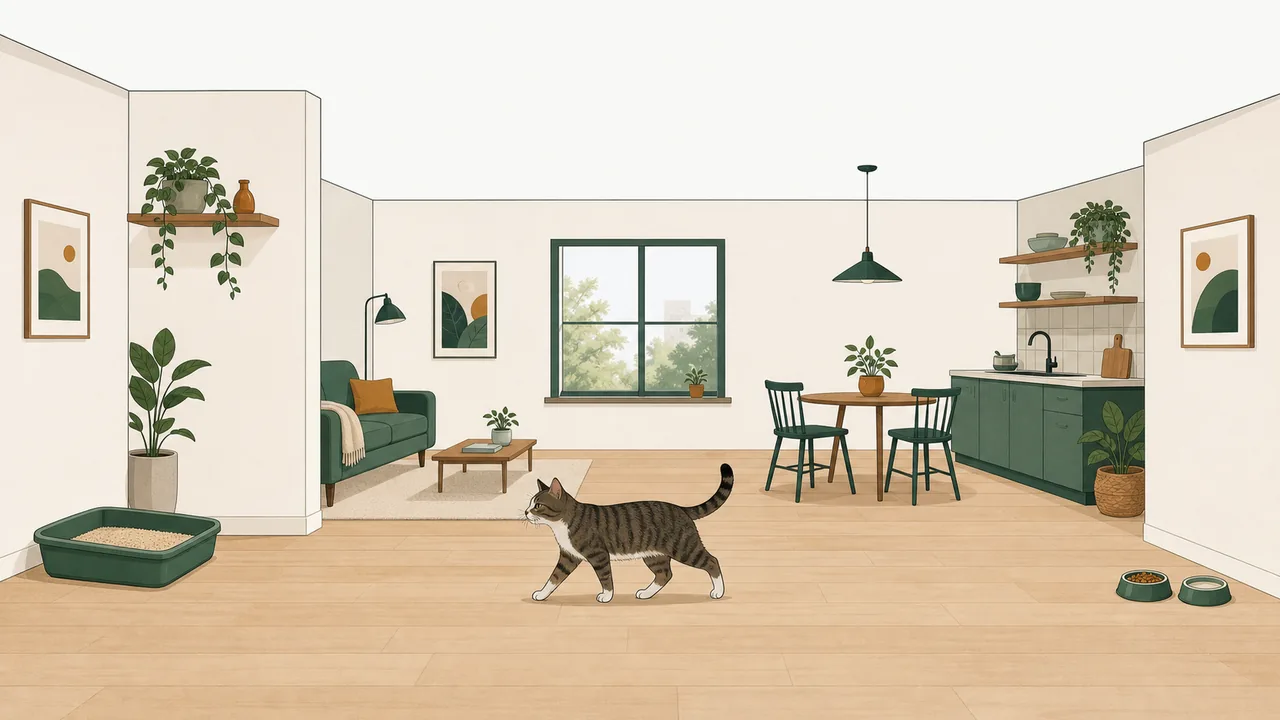
A litter box can be the right size, the right shape, and still go unused because of where it sits. Cats are picky about the bathroom for reasons that make sense once you see them as a small animal that does not want to be cornered: they want to go somewhere quiet, with a clear view and a way out, that does not smell like dinner. In a house you have options. In a one-bedroom apartment you have a kitchen, a bathroom, maybe a closet, and not much else — so the placement decision is tighter and matters more. If you have already chosen the box itself, this is the other half of the job; if you have not, start with how to choose a litter box for a small apartment and come back.
Keep it away from food and water
This is the rule that survives every cramped floor plan, and the one small apartments break most often because the kitchen and the only spare corner are the same corner. Cats generally prefer to keep their toilet away from where they eat, and feline-care guidance is consistent that boxes should be kept away from food bowls; a box pushed up against the food is a common reason a cat starts going elsewhere. Put as much distance as your layout allows between the box and the bowls — opposite ends of the room is the goal, and the more separation the better. In a studio where any distance feels generous, keep the box and the bowls on opposite sides, or use a piece of furniture or a half-wall to break the line between them. The point is that your cat should not have to eat next to the litter — the same distance rule, seen from the food’s side, is in the cat feeding station setup guide.
Quiet, but with a view and a way out
The instinct most people get backwards is hiding. It is tempting to bury the box in a closet or behind a closed door to keep it out of sight, but a cat using the litter wants to see what is coming and have more than one exit. The ASPCA puts it plainly: cats like to see people or animals approaching and to have escape routes, so a box wedged where the cat can be cornered — the back of a deep closet, a tight nook behind a door — can put them off it. Aim for a calm, low-traffic spot that still has an open sightline: the quiet end of a room, a corner that is out of the main walking path but not sealed away.
Just as important is what to keep it away from. Skip the spot next to the washer, dryer, or dishwasher; an appliance that suddenly roars to life mid-business can spook a cat badly enough that they avoid the area afterward. The same goes for the busiest stretch of hallway and anywhere drafty or pitch-dark. You are looking for the boring, slightly-out-of-the-way corner nothing dramatic happens in.
The placement test
Stand where the box will go and ask three things: Can the cat see the room from here? Is there more than one way out? Is anything loud, smelly, or high-traffic within a few feet? If you get a clean yes, yes, no, the spot is probably good — whatever room it happens to be in.
How many, and why not to line them up
Even in a small apartment, the long-standing guidance is one box per cat plus one spare — so two boxes for one cat, three for two. The instinct in a tight space is to solve that by standing both boxes side by side, which from a cat's point of view is just one big box, not two options. Feline-care guidance is consistent that boxes should be in separate spots so a more timid cat is never blocked from the only toilet by a bolder one or by a closed door. If your apartment genuinely has two usable locations — say the bathroom and a bedroom corner — use both, even if they are only one room apart.
The bathroom question
In most small apartments the bathroom is the honest answer, and it can be a good one: it is quiet, it has hard floors that are easy to clean, and it is usually out of the cooking and lounging zones. The catch is access and space. A box jammed between the toilet and the tub fails the "way out" test, and a bathroom door that swings shut becomes a locked door between your cat and the only box. If the bathroom is your spot, give the box a little breathing room rather than the tightest gap, and keep the door propped open with a wedge or a cheap door strap so it can never close the cat out. If you can spare an under-sink cabinet with the door removed, that can work too — as long as it stays open and ventilated, not a sealed box-in-a-box.
If your place has stairs or more than one floor
Small does not always mean one level — plenty of apartments and narrow townhomes stack rooms. The rule there is simple: put a box on every floor your cat actually uses. A cat relaxing upstairs should not have to make a trip down a full flight to reach a toilet, and that matters most for older or stiff cats, who may simply hold it or pick a closer corner rather than take the stairs. If you have a senior cat, make sure at least one box is on the level where they sleep and spend the day.
When placement isn’t the problem — see a vet
If a cat that used the box reliably suddenly starts going outside it, do not assume it is the spot and start rearranging furniture. Sudden avoidance can be a medical sign — some health problems can make using the box uncomfortable or urgent — and the ASPCA's first step is to rule out a medical cause with a veterinarian. Sort out the health question before you redo the setup.
Put together, good placement in a small space is less about finding a perfect room and more about clearing a short checklist in whatever rooms you have: away from food, quiet but open, never trapped, away from loud machines, spread out if you have a second box, and reachable without stairs for the cats who need it. Get those right and the box mostly takes care of itself; get the corner wrong and the nicest box on the market will still sit unused.
Still sorting out the box itself? Our companion guide on choosing a litter box for a small apartment covers size, type, and which expensive designs you can skip. If the same small space is losing a sofa corner to claws, the couch scratching guide handles that redirect. And if the box is for a kitten arriving this week, the new-kitten room setup guide covers the whole first room, low-sided box included. Adding a second cat is where the box count really matters — introducing a second cat in a small apartment covers the rest of that setup, and feeding stations for two cats in a small apartment handles the food side.
Review basis. This is a research-based home-setup guide drawing on ASPCA and Preventive Vet litter box guidance and the AAHA/AAFP feline life-stage guidelines. PawSetup did not test a specific home or invent owner anecdotes, uses no affiliate links, and offers general setup information — not veterinary advice for your individual cat.