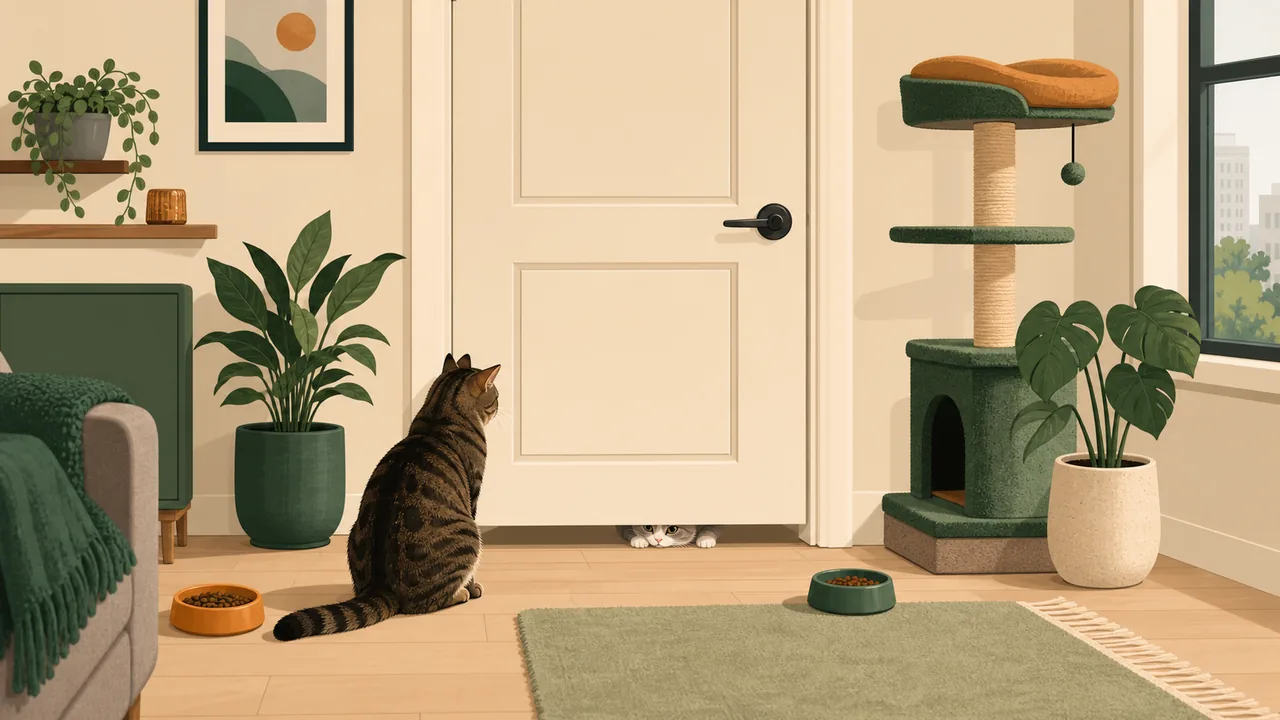
You signed for cat number two, carried the carrier through the door of a one-bedroom apartment, and now there is a standoff: the resident cat is flat-eared under the couch and the newcomer is growling from inside the crate. The usual advice starts the same way — keep the new cat in a separate room at first — and it is sound, but it quietly assumes you have a spare room to give. In an apartment you might have a bathroom and a lot of feelings about it. The protocol still works at small square footage. It just has to be adapted, and the one thing not to do is rush it because the space is tight. A cramped, hurried first meeting is exactly how two cats decide they are enemies.
First, accept that this is a slow project
The single non-negotiable comes from Cornell’s feline health center: keep a newly adopted cat separated from any resident cats until your veterinarian has examined the newcomer, especially when its health history is unknown. That gate exists to keep a contagious illness from spreading, and it conveniently buys you the time the introduction needs anyway. Book that vet visit before you start counting days.
It helps to understand why cats need the slow version when dogs often do not. To a cat, a new arrival is not a playmate showing up — it is a stranger in territory the resident has already claimed, so the goal is to make the introduction gradual enough that the resident never feels invaded. The whole technique is to let the two get used to each other’s smell and presence in stages, so that by the time they finally meet, neither one is a surprise. Done right, the meeting is an anticlimax. Done fast, it is a fight you then have to undo.
Set your expectations for the finish line, too. Two cats reaching easy tolerance can take weeks, and some pairs never become friends — they divide the apartment and ignore each other. That is a perfectly good outcome. You are aiming for peace, not a friendship you can’t force.
The base-camp problem when there is no spare room
The newcomer needs a base camp: a space you can close, stocked with its own food, water, litter box, bed, a hiding spot, and something to scratch. American Humane names the realistic apartment options directly — “a bedroom or bathroom” both work. A bathroom is a genuinely fine base camp, and it delivers something the protocol specifically wants: American Humane asks for “an inch or two of space under the door” so the cats can smell and paw at each other without seeing each other. Most bathroom doors already have that gap.
If you truly have no closeable room — a studio — partition a corner with a tall pet gate or two stacked baby gates, so there is still a barrier with airflow through it. It is a weaker version of a closed door, so expect to move even slower.
Whatever the space, stock it completely so the confined cat is not also deprived. Keep the litter box well away from the food and water, which is Cornell’s contamination rule, and make sure a hiding place — a box on its side counts — is in there from the first hour.
Scent before sight (the step people skip)
This is the part impatient owners skip, and it is the part that works. Trade scents before anyone sees anyone. American Humane suggests bringing home a blanket the new cat has slept on, then swapping bedding and toys between the two so each learns the other’s smell on neutral objects. The point is to get each cat used to the other’s smell before the two ever meet, so that when they do, the scent is already familiar instead of alarming.
Then feed them on opposite sides of the closed door. American Humane’s instruction is to “place both cats’ dishes close to the door, on their respective sides,” and to keep doing it until both cats eat calmly there. You are pairing the other cat’s smell with the best thing in a cat’s day. Start the bowls far enough back that nobody is too tense to eat, and move them closer over days only as the eating stays relaxed.
Next, swap territories. American Humane has you confine the resident cat in the base camp for a while and let the newcomer explore the rest of the home, then reverse it, so each cat investigates the other’s space and scent without a confrontation. In an apartment this is almost too easy: you are just rotating who is behind the door. Think of it as time-sharing the apartment — each cat gets the run of the place on its own schedule until the smell of the other is old news.
Then sight, then contact
Only after door-feeding is calm do you let them see each other, and even then through a barrier. American Humane’s marker is a gate “so they can see, smell and have contact with each other” but cannot actually reach each other — stacked baby gates if one of them is a jumper. Keep these visual sessions short and end them while they are still going well.
The barrier comes down only when the gate stage has become boring. Supervise the first real meetings and keep them brief. If a meeting tips into a real fight, do not reach between the cats with your hands; interrupt it from a distance and separate them. American Humane is plain that a fight in which one cat is traumatized or injured means the match will likely not work out without help — so treat a real fight as the signal to stop and call a vet or a qualified cat-behavior professional, not to try again tomorrow.
The rule that ties it all together is the regression rule, and it is American Humane’s most useful line: if either cat is growling or hissing through the door, do not put them together anytime soon, and if stress shows up at any stage, repeat the earlier exchange steps multiple times. Going back a step is the method, not a setback.
Make a small apartment feel bigger
Here is where the apartment angle actually changes the plan. Cats defuse tension by getting distance and height from each other, and a small floor plan gives them neither by default. So you add it. Vertical territory — a cat tree, a window perch, a couple of wall shelves — lets two cats share one room at different elevations and pass each other without a standoff. In limited square footage, going up is how you create the space you don’t have sideways.
Then there is the resource math apartment owners resist. The litter-box rule is one box per cat plus one — Cornell’s “as many litter boxes as you have cats, plus one,” with the ASPCA adding at least one per floor. For two cats that means three boxes, spread apart, not lined up in the same corner. It feels like a lot of boxes for a small place; it is also the single best insurance against a litter-box war, where one cat guards the only box and the other stops using it. Do the same for food, water, and beds: enough stations, far enough apart, that neither cat has to walk past the other to reach anything it needs. Synthetic pheromone diffusers are a low-cost, thin-evidence option some organizations suggest — fine to try, not a substitute for the steps above. The small-apartment litter box placement guide and the cat feeding station guide cover where all of this goes when floor space is scarce.
When to stop and call someone
Most of the time, slow and boring wins. But some signals mean the introduction has outrun what setup can fix, and pushing through is the wrong instinct. American Humane is plain about the worst case: if there is a fight in which one cat is traumatized or injured, the match likely will not work out without help. Treat these as stop-and-get-help signs: a real fight with injury; growling, hissing, or swatting that is not fading after weeks of careful steps; or a cat that stops eating, stops using the litter box, hides constantly, or otherwise looks stressed.
Any of those is a reason to slow down and to call your veterinarian or a qualified cat-behavior professional — and to see the vet first, because Cornell’s guidance is that a sudden behavior change can have a medical cause that needs ruling out before it is treated as a behavior problem. Inter-cat aggression is a genuine welfare issue for both cats, not something to muscle through on willpower. This guide covers the setup and the introduction; it is general information, not veterinary or behavior advice for your individual cats.
The short version
A small apartment does not change the steps; it shrinks your margin for error, so you go slower, not faster. Give the newcomer a base camp you can close — a bathroom counts — trade scents before sight, feed through the door, swap territories by rotating who is behind it, then a gate, then a short supervised meeting, and drop back a step the moment someone growls. Add height and triple the litter boxes so six hundred square feet can hold two cats. And if they are fighting, or one is hiding and not eating, that is a call to your vet or a behavior professional, not a willpower problem. Best case, they end up napping on the same couch. Acceptable case, they split the place and pretend the other doesn’t exist. Both are wins, and neither one happens in a weekend.
If a brand-new cat is what started this, the new-kitten room setup guide covers building that first base camp before pickup day, and if your household also includes a dog, the cat-to-dog introduction guide covers that pairing. More pet home setup guides follow as the collection grows.
Review basis. This is a research-based pet-setup guide drawing on American Humane’s cat-to-cat introduction protocol, the Cornell Feline Health Center’s new-cat guidance, and the ASPCA’s general cat care. PawSetup did not test anything, did not collect owner reviews for this guide, uses no affiliate links, and offers general information — not veterinary or behavior advice for your individual cats.