The adoption paperwork is signed, pickup is Saturday, and your apartment suddenly looks different to you — all cords and gaps and breakable things. Here is the part worth knowing before you buy anything: the veterinary guidance for a new cat’s first days asks for one prepared room. The whole-apartment kitten-proofing can wait, and so can most of the shopping — one room is a much shorter list.
Why one room beats the whole apartment
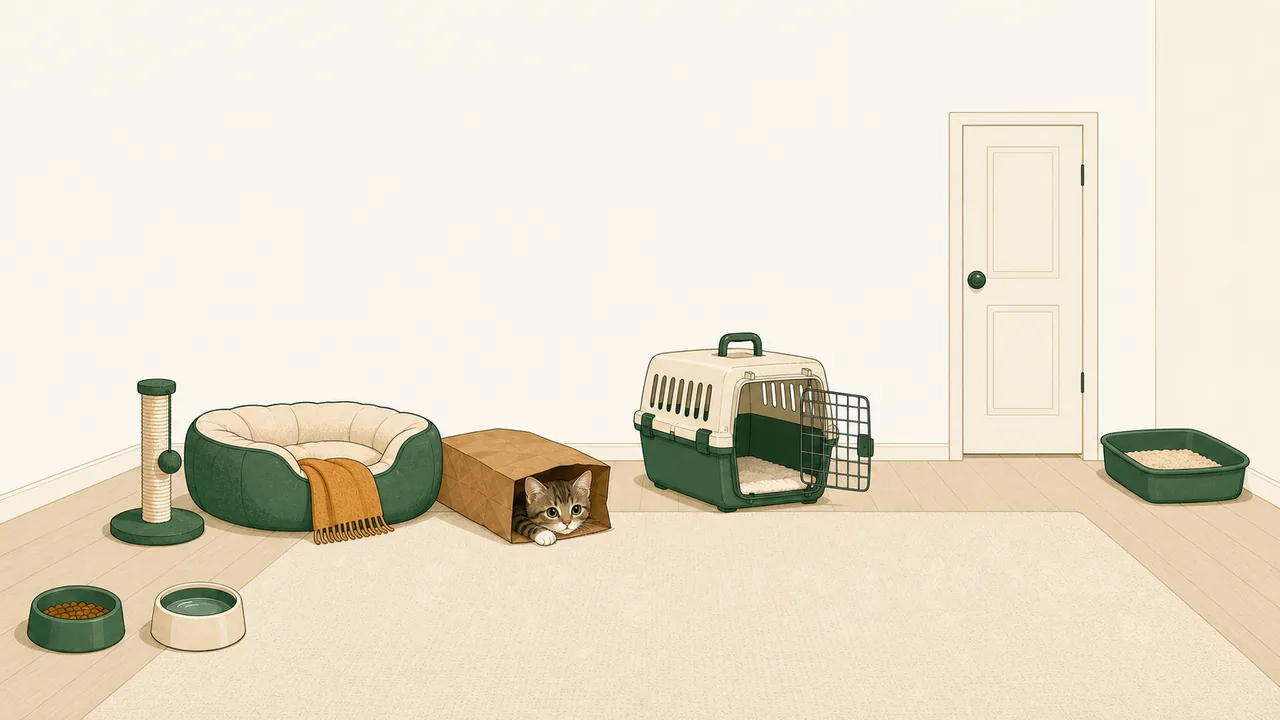
The AAFP’s Cat Friendly Homes caregiver guidance calls it a transition room: a quiet room you can close the door on, kept clean and uncluttered, where everything the kitten needs sits within a few steps. A whole apartment is a lot of new territory for a small animal. One room keeps the new world small while she settles, with everything she needs close at hand.
Set your expectations for what happens inside that room, too. The AAFP notes that many recently adopted cats hide for the first few days — if not the first week. Expect it and plan for it: hiding is the normal first move, and the room is built so that hiding somewhere safe while watching you is available from hour one.
One appointment belongs on the calendar before Saturday: Cornell’s feline health center says any new cat should be checked by a veterinarian as soon as possible after coming home. And if you already have cats, Cornell is specific: keep the newcomer separated from them until your veterinarian has examined her — especially when her health history is unknown. The transition room solves that requirement for you; cat-to-cat introductions are their own project for after the all-clear.
Map the room in three zones
The furniture matters less than the spacing. Three zones, as far apart as the room allows.
The sleeping and hiding corner. A bed lined with a soft, warm blanket or towel, per the ASPCA’s care basics — and at least one dedicated hiding place beside or instead of it. This does not need to be bought: the AAFP’s suggestion is that a paper bag on its side will work. A cardboard box does the same job. What matters is that it exists on day one, so “somewhere to disappear” is part of the room, and under the dresser doesn’t have to be.
The food and water spot. Separate dishes for food and water, kept — in Cornell’s words — far away from the litter box to avoid contamination. Keep the dishes clean and the contents fresh; Cornell notes cats may reject old food or stale water. On the food itself, keep it simple this week: a complete diet formulated for kittens, starting with whatever she was eating at the shelter and switching gradually, which is Cornell’s recommendation for any new cat. If you want the full geometry of bowls done right, the cat feeding station guide goes deeper.
The litter corner. For a kitten, the box itself has one extra requirement: Cornell flags that kittens may need sides low enough to step into easily — the tall covered box can wait. Fill it with unscented clumping litter, which is what the AAFP’s transition-room guidance specifies, and put it in the quietest reachable corner, farthest from the food. Scoop daily. When she graduates to the whole home, the ASPCA’s rule of one box per floor — and Cornell’s “as many boxes as you have cats, plus one” — will tell you what to add; the litter box placement guide covers where they should go.
One more thing belongs in the room from the first hour: a scratching post. Cornell lists one among the basic provisions to have ready before the cat comes home, so a scratch-friendly surface is part of her world from day one. A kitten does not need the full adult tower yet (the ASPCA’s adult guidance is a sturdy post at least three feet high, surfaced in something rough like sisal), but sturdiness matters at every size: the ASPCA’s spec is a post stable enough that it will not wobble, and a tippy post fails that test at any height. When she starts testing your furniture anyway, the couch-scratching redirect guide is the playbook.
Make the room boring to get hurt in
Kittens investigate with teeth and paws, so the proofing pass is mostly subtraction. Humane World for Animals keeps a list of everyday household hazards; start with four high-priority items from it:
- Electrical cords. Chewed cords can cause shocks, burns, or electrocution. Unplug what you can, lift the rest out of reach, and cover or wrap anything that must stay.
- String, ribbon, yarn, and anything that dangles. Swallowed string can cause an intestinal blockage. That includes the strings on blinds — tie them up — and wand toys, which are for supervised play and then go in a drawer.
- Houseplants. Lilies, azaleas, and tulip bulbs are on Humane World’s sicken-if-ingested list, along with many other plants. Move every plant out of the room rather than researching each one tonight.
- Medications and cleaning chemicals. Human medications can cause severe harm to pets, and cleaners like bleach and drain or oven cleaner can burn skin and worse if ingested. If your transition room is a bathroom, the under-sink shelf and the counter empty out first.
Ten minutes on the floor — literally, at kitten eye level — finds the gap behind the bookcase and the cord you forgot.
The first 48 hours: do less than you want to
Carry her in, in a covered carrier, set it down in the room, and open the door of it. Then comes the hard part: let her decide what happens next. The AAFP’s guidance is to let the cat choose when to come out and explore, and not to force her to stay near you. If she goes straight under the bed and stays there through dinner, the plan is working — that is what the hiding place was for.
The AAFP makes one observation that lands hardest in family homes: it is tempting, especially for children, to rush in and cuddle the new arrival. The kitten may simply not be ready, and the AAFP’s advice is to let her decide if, and when, she approaches family members. Better tools than hands: a wand toy played near her hiding spot, or just sitting quietly in the room while she eats — the two approaches the AAFP suggests for coaxing a new cat closer.
When the door opens
She sets the schedule for expanding her territory. The AAFP’s marker: after a few days, or whenever she is comfortably walking around and living in the room rather than hiding in it, you can open the door to the rest of the home. Some cats need several weeks to get there. Either pace is fine. Think of the room as a base camp, and leave it set up as her retreat even after the door opens.
If there is a resident cat on the other side of that door, the door stays closed longer — through the vet check at minimum, per Cornell, and then through a proper gradual introduction — its own project, walked through in how to introduce a second cat in a small apartment.
The before-Saturday shopping list
Condensed from the ASPCA’s supply checklist and the guidance above:
- Litter box with low sides, plus unscented clumping litter and a scoop
- Two separate food and water dishes, and the food she already eats
- A bed lined with a warm blanket or towel, and a hiding place (a box or paper bag counts)
- A scratching post stable enough not to wobble (kitten-sized is fine; the three-foot spec is adult guidance)
- A few solo toys for the room; a wand toy for supervised sessions
- A carrier she will come home in — and a collar with ID tag or a microchip plan, the ASPCA’s safeguard for getting a lost cat home
That is the whole setup. A door, three well-spaced zones, nothing dangling, and a human willing to be ignored for a few days. The finish line is the AAFP’s own marker — a kitten comfortably walking around and living in the room. When you see that, the hallway is next, and base camp has done its job.
A boundary worth stating plainly: this guide covers the room. If your new kitten will not eat, seems lethargic, or worries you in any way that goes beyond shyness, call your veterinarian rather than adjusting the furniture — a new kitten’s first days are exactly when a vet’s eyes matter most, and Cornell’s “as soon as possible” checkup exists for that reason. This is general setup information, not veterinary advice for your individual kitten.
More pet home setup guides follow as the collection grows — including choosing a cat brush for shedding once she has settled in, and cat-proofing the windows before warm-weather window season.
Review basis. This is a research-based setup guide drawing on the Cornell Feline Health Center’s new-cat care guidance, the AAFP’s Cat Friendly Homes page on introducing a new cat into your home, the ASPCA’s general cat care basics, and Humane World for Animals’ household-hazards guidance. PawSetup did not test a specific product, did not collect product reviews for this guide, uses no affiliate links, and offers general information — not veterinary advice for your individual kitten.