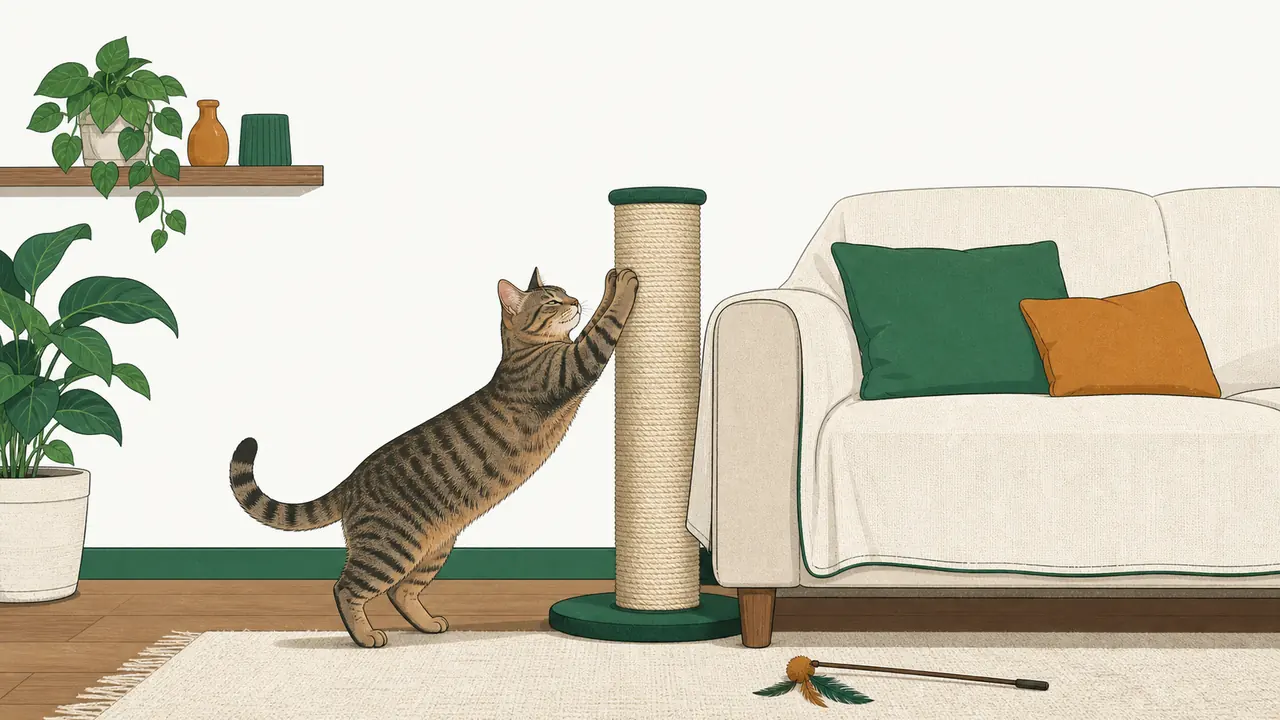
The corner of your sofa is fraying, the spray bottle made her flinch but not stop, and you are one shredded armrest away from googling slipcovers. Before you do: the feline veterinary organizations that study this are blunt about two things. The scratching will not stop, and punishing it backfires. What changes is where it happens — and you have more control over that than the state of your couch suggests.
Start with why the couch, of all things. Scratching is innate — Cornell’s feline health center puts it in the same category as grooming and burying waste. It deposits scent from glands in her paws, peels the worn outer sheath off her claws, and gives her a full-body stretch, usually right after a nap. Your couch is tall, absolutely rigid, wrapped in grippy fabric, and parked in the room where she sleeps. She did not choose it to spite you; the AAFP’s caregiver guidance says exactly that. She chose it because it is the best scratching object you own. The plan, then, is not to defend the couch. It is to beat it.
Watch one scratch before you buy anything
The next time she goes at it, watch for ten seconds. Cornell’s guidance starts with exactly this observation: does she scratch vertically, paws stretched above her head, or does she work flat surfaces like the rug? And what is she digging into — woven fabric, carpet, wood?
That observation is your shopping list. A cat who climbs the couch arm wants a vertical post. A cat who rakes the carpet wants a horizontal scratcher — the AAFP says to try one specifically if carpet is the target, and Cornell’s budget version is a flattened cardboard box or a log on its side. Matching her preferred direction and texture, Cornell says, is vital; a scratcher that matches your decor but not her habits will be furniture she walks past on the way to your sofa.
The post has to beat the couch on its own terms
Whatever you pick has to survive comparison with a sofa, and the bar is concrete. It must not wobble — Cornell says sturdy enough that it cannot topple during use, because the couch never moves and she knows it. It must be tall enough for the full stretch: as Cornell puts it, at least as tall as your cat standing on her hind legs with her front legs outstretched. Humane World for Animals puts a number on it: at least 32 inches.
Texture is the last variable. Many cats prefer sisal rope; others go for corrugated cardboard, carpet, or bare wood. The AAFP’s honest answer is that you experiment — preference is individual, and the first texture you try may not be hers. A cheap cardboard scratcher set out next to a sisal post tells you quickly which way she leans.
Put it where the damage is
Placement decides most of the outcome. The AAFP’s instruction is uncomfortably specific: put the scratcher near where she is scratching now — in front of the couch leg, against the scratched arm. Add one near her sleeping spot, because cats typically stretch and scratch the moment they wake. Cornell adds the consolation that this is not forever: start the post where the scratching happens, and once the habit moves, you can shift it gradually toward a spot you like better.
Tucking the post in a spare room defeats the mechanism: a scratcher she never walks past cannot compete with a couch she sleeps on. If you have more than one cat, multiply: the AAFP’s caregiver guidance calls for ample resources in multiple locations, because a single contested post becomes one more thing to compete over — and that competition itself can drive more scratching.
The whole plan in one paragraph
One scratcher that matches how she scratches, standing against the damaged corner. A sheet or double-sided tape on the couch while the habit moves. A treat within three seconds every time her claws land on the post. That is the whole machine — the rest of this guide is tuning.
Make the couch the worse option
While the post is winning her over, take the couch out of the running. The AAFP lists the first-step deterrents plainly: two-sided sticky tape, tinfoil, plastic, or a furniture cover on the scratched section. Humane World’s version is a tight-fitting sheet over the target area. None of it needs to be permanent — the point is that the corner stops feeling good to scratch while the post next to it feels excellent. One caveat from the AAFP: a cat who likes to chew plastic should not get plastic sheeting.
Clean the scratched spot too, with plain soap and water. Scratching leaves scent marks, and Cornell notes cats are more likely to re-scratch surfaces that already carry their scent — a freshly cleaned corner loses some of its pull. If stress seems to be part of the picture, the AAFP suggests considering synthetic facial pheromones — sprayed on the previously scratched areas after cleaning, or run as a room diffuser. Just never applied to the scratcher itself, which is the one thing you want her to mark.
Reward fast, lure — never force
When she touches the post, pay her immediately. The AAFP is precise about the window: within three seconds, with something she actually values — a treat, a moment of play, petting, a pinch of catnip. Slower than that and the reward stops connecting to the scratch.
Getting her to that first scratch is a luring job. Play around the post with a wand toy so her claws land on it mid-game; rub catnip on it for the first several days. What you should not do is grab her paws and rake them down the surface — Humane World warns that forcing it can create a stress response and put a cat off the post entirely. (The AAFP’s gentler version: pick her up calmly, set her down at the scratcher, reward within three seconds.) The agreement underneath both: nothing forced, payment immediate.
One more habit worth resisting later: when the post finally looks shredded and disreputable, leave it. Cornell’s line is that a ragged post is a well-used post — replace it and you erase the scent and texture record that made it hers.
The two things that make it worse
Punishment is the first. Cornell’s explanation of why is specific: yelling, a water gun, or a startling noise teaches her that your presence, rather than the act of scratching, brings punishment — so she keeps scratching, just when you are out. It can also tip into aggression. The AAFP adds the loop that makes the spray bottle truly counterproductive: anxiety intensifies scratching, and punishment intensifies anxiety.
Declawing is the second, and the position of the veterinary organizations is hard to misread. Cornell describes it as an amputation of the bones at the tips of the paws — not a nail trim — and something to consider only as an absolute last resort after every strategy above has genuinely failed, in conversation with your veterinarian. Humane World’s position article on the subject is titled “Why Declawing Is Never the Solution.” If you feel pushed toward it, that is a conversation for your vet, not a checkout button.
When the couch is a symptom
Most couch scratching is ordinary cat behavior aimed at a convenient object. But the AAFP flags one pattern that deserves attention: scratching that has increased. More scratching than before can be a stress signal — something threatening her resources, tension with another cat in the house (the signs of which are famously subtle), or an outdoor cat she can see or smell through a window or door near the scratched spot. In that last case, blocking the view can matter as much as any post.
Keep up regular nail trims meanwhile — they limit the damage while the redirect takes hold, and your vet can demonstrate the technique. Soft nail caps exist as a stopgap; the AAFP notes they need redoing every four to six weeks (Cornell says six to twelve) and calls them a less desirable alternative to the methods above.
And if the scratching keeps climbing, or the redirect simply is not landing after a fair trial, bring your veterinarian into it — they can rule out causes you cannot see from the living room, and a veterinary behaviorist is the next step for a genuinely stuck case.
The couch was never the enemy; it was just the tallest, steadiest thing in her territory. Give her something that beats it, parked where the crime scene is, and pay her on time — then let the post take the damage. A ragged scratcher is the cheapest furniture repair you will never have to make.
If the same room also holds her bowls and litter, the geography matters there too — see the cat feeding station guide and the litter box placement guide — and if you are starting a post from day one with a new arrival, the new-kitten room setup guide explains why that timing helps. More pet home setup guides follow as the collection grows.
Review basis. This is a research-based setup guide drawing on the Cornell Feline Health Center’s destructive-scratching guidance, the AAFP’s Cat Friendly Homes caregiver pages on scratching and living with a clawed cat, and Humane World for Animals’ scratching-post guidance. PawSetup did not test a specific product, did not collect product reviews for this guide, uses no affiliate links, and offers general information — not veterinary advice for your individual cat.