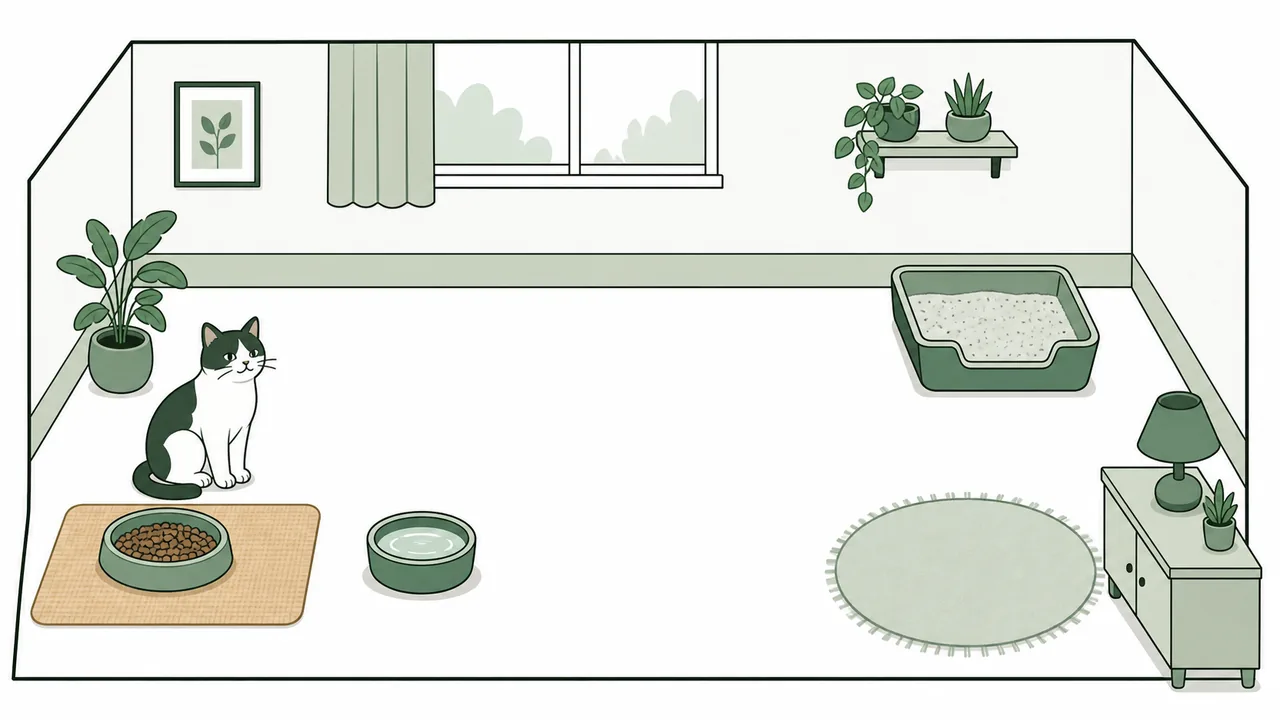
A cat feeding station is not a piece of furniture you buy. It is three decisions about where two bowls go and what they are made of — and in a small home, the room itself forces your hand, so it helps to make those decisions on purpose instead of by default.
Walk into most studios and one-bedrooms and the cat’s things have collected wherever there was a free patch of floor: the bowls by the fridge, the water next to the food, the litter tray tucked into the same nook because there was nowhere else. None of that is a disaster. But cats are fussier about the geography of eating than people expect, and the most common small-apartment layout breaks two of their preferences at once.
Get the bowls away from the litter box first
If you change one thing, change this. Food and a litter tray in the same corner is the setup cats object to most, for a plain reason: a cat covering up after itself kicks litter around, and stray particles and odor drift onto nearby food and water. Vet-reviewed feeding guidance is consistent that bowls belong a real distance from the tray — a different room if your floor plan allows it, and at minimum the opposite side of the room, not the adjacent corner.
In a studio “a different room” may not exist. That is fine; you are looking for the longest diagonal you can manage. Put the litter in the spot you can stand to give up — often a bathroom — and the bowls as far from it as the walls allow. The smell test is literal here: if you can smell the tray from where the food sits, so can the cat, and a cat that associates its dinner with its toilet may eat less or graze oddly.
Split the food from the water
The second habit worth breaking is the matched food-and-water pair sitting side by side. A lot of cats prefer them apart. The explanation usually offered is instinctive — in the wild a cat would not drink right next to a kill — and whatever the cause, the practical version holds up: crumbs and food smell fouling the water beside the bowl is enough to put a fussy drinker off it.
So separate them. A few feet is a noticeable improvement over touching; a water bowl in a different part of the room, or a second small one elsewhere in the apartment, is better still. There isn’t strong research pinning down the ideal spot — Purina’s own guidance is to watch your cat’s preference — but a clean, food-free water spot removes one common reason a fussy cat walks away from its bowl. You do not need a fountain to do this; you need distance.
The corner matters as much as the bowl
Cats don’t like eating with their back exposed or their head jammed into a tight angle where they can’t see the room. Pick a calm, low-traffic spot with a bit of open sightline — off the main walking lane, away from the washing machine and the bin, and not under a spot that gets loud at dinnertime. And keep it consistent: cats are creatures of habit, and the bowls staying in the same place every day is part of what makes a nervous eater relax.
The bowl itself: skip plastic
Bowl material is the one part of a feeding station with a genuine health angle, and it is worth getting right because it is so cheap to. Plastic dishes scratch with use, and those scratches hold bacteria that ordinary washing can’t fully clear. The VCA notes there may be an association between plastic food and water dishes and feline chin acne — the crusty bumps some cats get on the chin and lower lip — and that switching to a non-porous, smooth-surfaced bowl like stainless steel or glass, plus washing it daily, can help resolve it in some cats.
So the safe default is a stainless steel or smooth ceramic bowl, washed every day the way you’d wash your own plate, not refilled on top of yesterday’s film. Ceramic is fine until it chips or crazes; once the glaze is cracked it can harbor bacteria like scratched plastic, so retire a chipped bowl rather than nursing it along. If your cat already has chin bumps or any skin irritation, change the bowl, but treat that as a reason to call your vet, not a problem a new dish alone will fix.
You’ll also see wide, shallow bowls sold for “whisker comfort,” the idea being that a deep narrow bowl presses a cat’s whiskers against the sides. The hard evidence for whisker stress is thin, so treat it as a low-cost preference rather than a rule: a shallow saucer-style dish is cheap, easy to clean, and some cats seem to prefer it, which is reason enough to try one without believing it cures anything.
More than one cat means more than one station
If you have two or more cats, two bowls in a row is not two feeding stations — it’s one crowded one. Feline environmental-needs guidance from the American Association of Feline Practitioners and International Cat Care is specific on this: every cat should have its own separate feeding station, and food, water, and litter should be offered as multiple, separated resources rather than clustered in one spot. The reason is competition — a shared bowl lets a bolder cat crowd out a less assertive one, who hangs back, eats in a hurry, or quietly loses ground at mealtimes. So give each cat its own bowl and spread the stations out, even into different rooms in a small flat. The same goes for water: a couple of separated spots beat one shared bowl.
When it’s not a setup problem
Layout fixes a lot, but it doesn’t fix everything, and a few signs mean the answer is a vet rather than a rearrangement. A cat that suddenly stops eating, eats noticeably less, drinks a lot more or less than usual, or develops sores on the chin or face needs a professional look — appetite and thirst changes can signal health problems that no bowl placement will solve. Move the station first if it’s obviously wrong, but don’t spend weeks redecorating a corner when the real issue is one your veterinarian should see.
None of this needs a gadget or a special piece of cat furniture. A feeding station that works in a small apartment is mostly subtraction: pull the bowls away from the litter, put a little distance between the food and the water, find a calm corner the cat can eat in without watching its back, and use a bowl you’ll actually wash. Get those right and the fanciest fountain or raised feeder is optional — for most cats, in most small homes, it’s the placement that was the problem.
The flip side of this is where the litter goes, which has its own short list of rules in a small space — that’s the litter box placement guide. And if the same room’s sofa corner is taking claw damage, the couch scratching guide covers the redirect. Setting all of this up for a brand-new arrival? Start with the new-kitten room setup guide, or if you are adding a cat to a one you already have, introducing a second cat in a small apartment. Already feeding two cats? The placement changes — see feeding stations for two cats in a small apartment. More pet home setup guides follow as the collection grows.
Review basis. This is a research-based setup guide drawing on vet-reviewed feeding guidance (Catster, Purina), VCA Animal Hospitals’ guidance on feline chin acne and bowl material, and the AAFP/ISFM Feline Environmental Needs guidance on providing separated resources in multi-cat homes. PawSetup did not test a specific product, did not collect product reviews for this guide, uses no affiliate links, and offers general information — not veterinary advice for your individual cat.