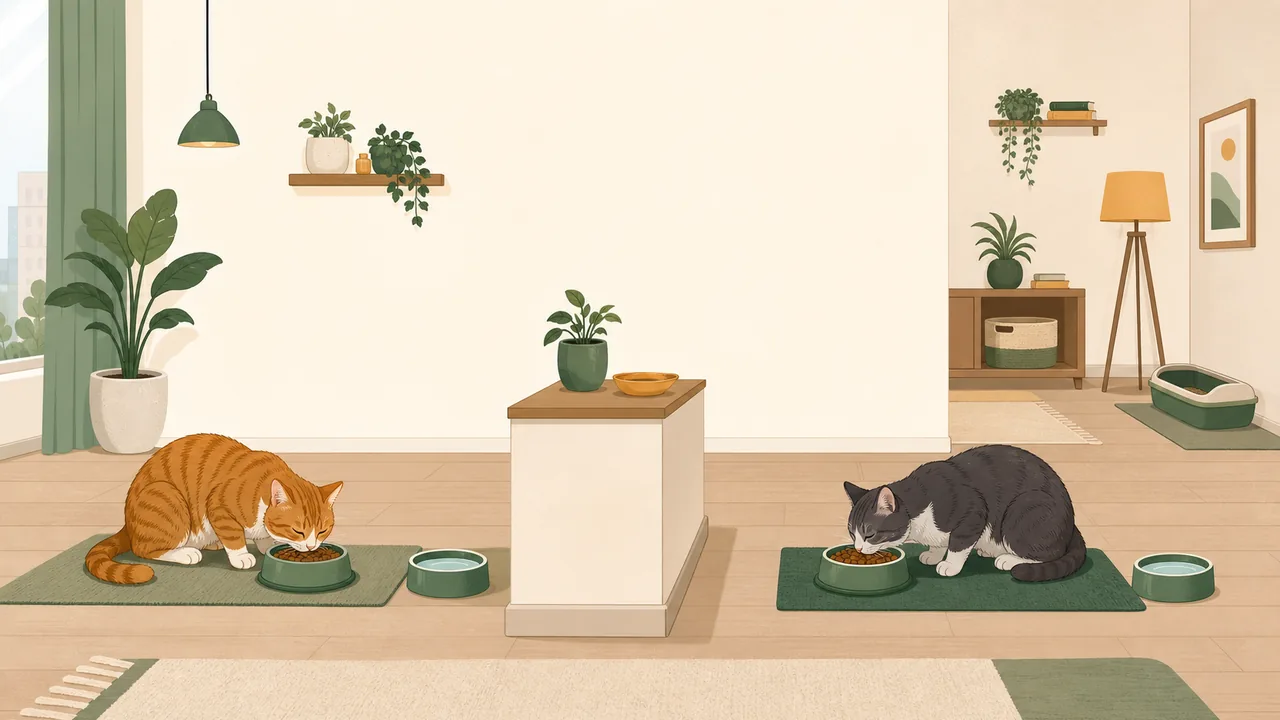
You set two bowls down side by side, because that is what fits in the kitchen corner. Then the food-motivated cat finishes first and pushes into the other’s bowl. PetMD puts the pattern plainly: it is “not unusual for one cat (or more!) in a household to be very food-motivated and bully their way into everybody else’s food bowls,” and the fallout is real — “some individuals gaining unhealthy amounts of weight and others becoming undernourished,” along with “aggression, anxiety, and injuries caused by fights.” In a small apartment it can feel like there is no room to fix that. There is. You stop running one shared feeding spot and set up two.
All of this traces back to one idea from the AAFP and ISFM feline environmental needs guidelines, summarized by VCA: a cat’s key resources should be “available in multiple places,” and “each resource should be in its own location separate from the others.” In a multi-cat home, “each cat should have access to their own resources.” PetMD says the same thing in kitchen terms — “every cat should have their own spot to eat and drink.”
Why two bowls in one corner works against you
Cats, as Preventive Vet puts it bluntly, “are not social hunters or eaters,” and “they prefer to eat with some distance between them.” Put both bowls in one place and you hand a food-motivated cat an easy spot to crowd, the exact conflict the guidelines are built to prevent. PetMD ties shared bowls to weight problems at both ends and to food-related “aggression, anxiety, and injuries caused by fights.” Splitting the stations takes that pressure out of the room: with a spot of its own, each cat can eat at its own pace.
The small-apartment layout, in order of preference
You do not need a big home for this. You need distance and a sightline break.
Best, if you can manage it: different rooms. PetMD calls “feeding each cat in a separate room behind a closed door” the “ultimate solution for serious mealtime problems,” and Preventive Vet likewise puts feeding stations “up in separate rooms” for cats that finish at different speeds. Even a one-bedroom gives you two usable zones — one cat fed in the kitchen, the other in the bedroom or by a window. Reach for this version when one cat is being kept from its food, because the cats are fully out of each other’s view.
When one room is all you have: as far apart as practical. PetMD’s rule for the same room is direct — “keep your cats’ feeding stations as far apart as is practical.” Opposite ends of the room, or around a corner from each other, so the cats are not eating nose to nose.
Count the stations. VCA’s guidance is that cats should have “at least two options for each resource, such as two feeding areas.” In a two-cat home that means one station per cat, and each station is that cat’s own food and water — PetMD’s “their own spot to eat and drink,” not a shared dish pile.
Keep water and the litter box out of the equation
Two more placement rules carry over from the same guidelines, and both matter more in a small space where everything wants to live in one corner.
Water is its own resource. The guidelines put each resource in its own location, so rather than clustering food and water in a single dish-pile, give each cat its water a step away from its food. And keep the bowls away from the litter box: VCA is explicit that “the food bowl should not be near the litter box.” In a small apartment that is the easiest rule to break. If you have already mapped out where the litter box goes, build the feeding stations on the opposite side of that plan. (If you are still working out the single-cat basics first, the cat feeding station guide covers one-cat placement.)
When same food and same schedule won’t work
Sometimes the problem is not space but mismatch — one cat needs a prescription or weight-control diet, or one clears both portions before the other starts. Two fixes are worth knowing. First, scheduled meals instead of a bowl left out all day: Preventive Vet suggests a cat “should eat at least 3 times daily,” with “no more than 8 hours between meals,” and when nothing is left standing, there is no open bowl for another cat to raid. Preventive Vet also notes that setting feeding stations “up in separate rooms” helps when one cat finishes first.
For a fast eater specifically, Preventive Vet’s approach is to slow the eating down rather than pile on gear: “feed their meals in a food puzzle,” or “put something in their food bowl that forces them to slow down a bit,” which buys the slower cat time to finish. And when two diets genuinely cannot mix, a microchip feeder is built for exactly that — PetMD describes one that “opens and provides food only when a particular cat approaches,” and Preventive Vet adds that “when that cat steps away, a door closes, covering and protecting the food.” It answers a specific problem, not a purchase to default to on top of a separated two-station setup.
When it is a vet conversation, not a furniture one
Setup handles competition between healthy cats. A medical change is a different matter, and a layout tweak should not paper over one. PetMD notes that “a change in appetite is an early symptom of many cat diseases,” so a cat that suddenly eats much more or much less, or loses or gains weight, is a reason to call your veterinarian. The same goes for food conflict that hardens into real fighting: PetMD warns that conflicts around food can bring “aggression, anxiety, and injuries caused by fights,” which is a conversation for your vet or a qualified behavior professional rather than another bowl rearrangement.
The working setup for a two-cat apartment is short: at least two feeding stations, one per cat, as far apart as your space allows, each with its own food and water, and the whole arrangement kept clear of the litter box. Cats “prefer to eat with some distance between them,” as Preventive Vet puts it, so give the cat that keeps getting crowded the more separated station. Then watch how each cat eats over the next week and adjust. If a cat’s appetite itself changes, that is a question for the vet.
For more on arranging a small space around your cats, the single-cat feeding station guide and the litter box placement guide sit alongside this one, and more pet home setup guides follow as the collection grows.
Review basis. This is a research-based pet-setup guide drawing on PetMD’s multi-cat feeding guidance, VCA’s summary of the AAFP/ISFM feline environmental needs guidelines, and Preventive Vet’s multi-cat feeding tips. PawSetup did not test anything, did not collect owner reviews for this guide, uses no affiliate links, and offers general information — not veterinary advice for your individual cats.