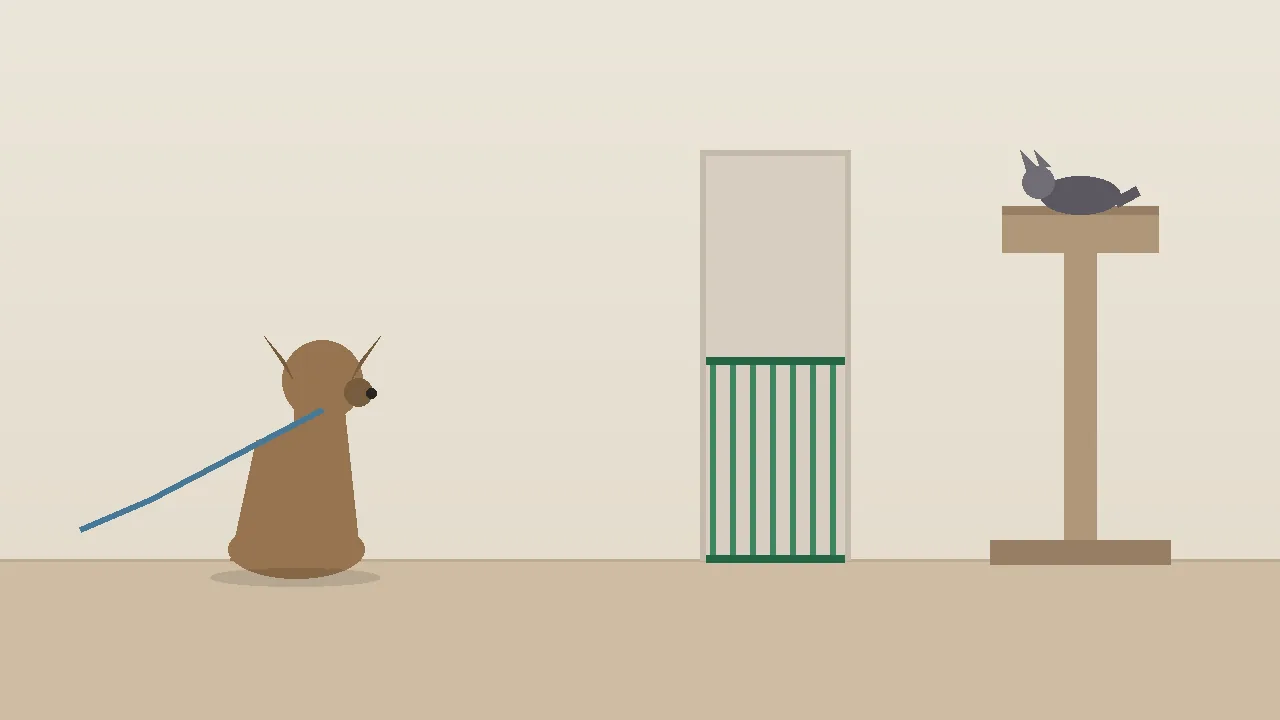
Bringing a cat and a dog under one roof is nerve-wracking in any home; in a one-bedroom it feels impossible, because the usual advice — “keep them in separate parts of the house for a week” — assumes parts of the house you do not have. You can still do this safely. The plan is the same one the shelters use, adapted to the square footage you actually have: separate first, let them meet through scent before sight, and make the first face-to-face meeting slow and controlled. What follows is that path, plus the signals that tell you to back up a step.
First: separate, even without a spare room
Start them apart. You do not need a spare bedroom — a bathroom or the bedroom works as what Best Friends Animal Society calls the cat’s room, with “a tall baby gate across the door.” The gate matters in a small place because it lets the two see and smell each other without contact, which is most of the early work. Give the cat what the San Francisco SPCA stresses it needs in shared territory: a safe room plus “high places the cat can access but the dog cannot,” so the cat can “retreat and regroup away from the dog, and then venture forward into dog territory at their own pace.” In an apartment, that vertical escape is often a cat tree or a cleared shelf — up is where a cat goes to feel safe when there is nowhere to go sideways.
Scent before sight
Before they ever meet face to face, let them get used to each other’s smell. Best Friends suggests you “swap out the blankets and bedding of each animal, giving it to the other,” so each becomes familiar with the other before there is a face attached to it. Pair that with mealtimes: feed “each animal on their side of the door,” the cat just inside its room and the dog on the other side, so both come to associate the other’s scent with something good. The SF SPCA makes the same point about keeping food separate — feed the cat in its safe room or on a high surface — which in a small apartment also keeps the dog from inhaling the cat’s food and crowding its space.
The first meeting: leashed and slow
When both animals are calm on their own sides of the door — eating, relaxed, not fixating — you can try a face-to-face meeting, and the rule for it is simple: the dog is on a leash. The SF SPCA puts the reason plainly: have the dog on a leash for the first introduction “in case they explode into chase mode.” Best Friends adds the staffing: “one person should hold the dog on a loose lead and watch the dog’s body language,” while “someone else should watch the cat’s body language.” A loose lead, not a tight one — tension travels down the leash. And do not stage-manage the cat into it: the SF SPCA is firm that you should “never force the cat (or dog) into proximity by holding, caging, or otherwise restricting their desire to escape.” The cat needs to be able to leave, which is exactly why you set up those high spots first.
Read the dog: the signals that mean stop
This is the part to take seriously, because a dog’s interest in a cat can be friendly or it can be predatory, and they do not look the same. Best Friends says to watch for a dog “staring at the cat, has stiff body language,” or one that “lunges and tries to chase the cat.” The SF SPCA’s list of predatory warning signs is more specific: “instant attempts to chase, out-of-control straining at the leash, whining, barking, and agitation.” If you see those, the meeting is over for now — calmly end it, give the cat its space back, and go back to the door-and-gate stage. None of that means the introduction has failed; it means today’s session went past where the dog could stay calm, and the fix is more distance and more time, not more exposure.
Living with it day to day in a small space
Even after a few good meetings, do not treat the job as finished. Best Friends is explicit: “keep kittens and dogs apart any time you are not watching them” until a solid relationship has developed. In a small apartment that means the safe room and the baby gate stay in use when you are out or asleep, and the cat keeps its high perches and a clear path to them. The thing to track is the direction, not any single bad moment. The SF SPCA frames it well: “in the first few weeks, observe the trend: are things getting better or worse?” and keep monitoring “until there is a pattern or plateau in their relationship.” Better-each-week is what you are looking for.
When to bring in a professional
Some pairings need more than a careful owner, and recognizing that early is part of doing this well — not a failure. If the trend is going the wrong way, if the dog stays fixated or keeps trying to chase, or if either animal cannot settle, Best Friends’ guidance is direct: “if introductions don’t go well, seek help from a professional dog trainer or behavior consultant.” And if there is ever a scuffle that breaks skin or leaves a limp, that is a veterinary visit, not a wait-and-see. This guide is general information, not veterinary or behavior advice for your specific animals, and a professional who can watch your dog and cat in your home will always beat a checklist.
The short version for a one-bedroom: set up a closeable safe room with high places the cat can reach and the dog cannot; swap bedding and feed on opposite sides of the door before any meeting; keep the dog on a loose leash for the first face-to-face, with one person watching each animal; stop and back up if the dog fixates, strains, or tries to chase; keep them apart whenever you are not watching until the relationship is solid; and call a trainer or behavior consultant if the trend is not improving. If you are also weighing a second cat instead, our guide to introducing a second cat in a small apartment covers that cat-to-cat version, and the new-kitten room setup covers building the safe room itself. More pet home setup guides follow as the collection grows.
Review basis. This is a research-based pet-setup guide drawing on Best Friends Animal Society and the San Francisco SPCA. PawSetup did not test anything, did not collect owner reviews for this guide, uses no affiliate links, and offers general information — not veterinary or behavior advice for your individual animals. Persistent chasing, fixation, or fear is a reason to consult a professional dog trainer or behavior consultant; any injury is a reason to see a veterinarian.