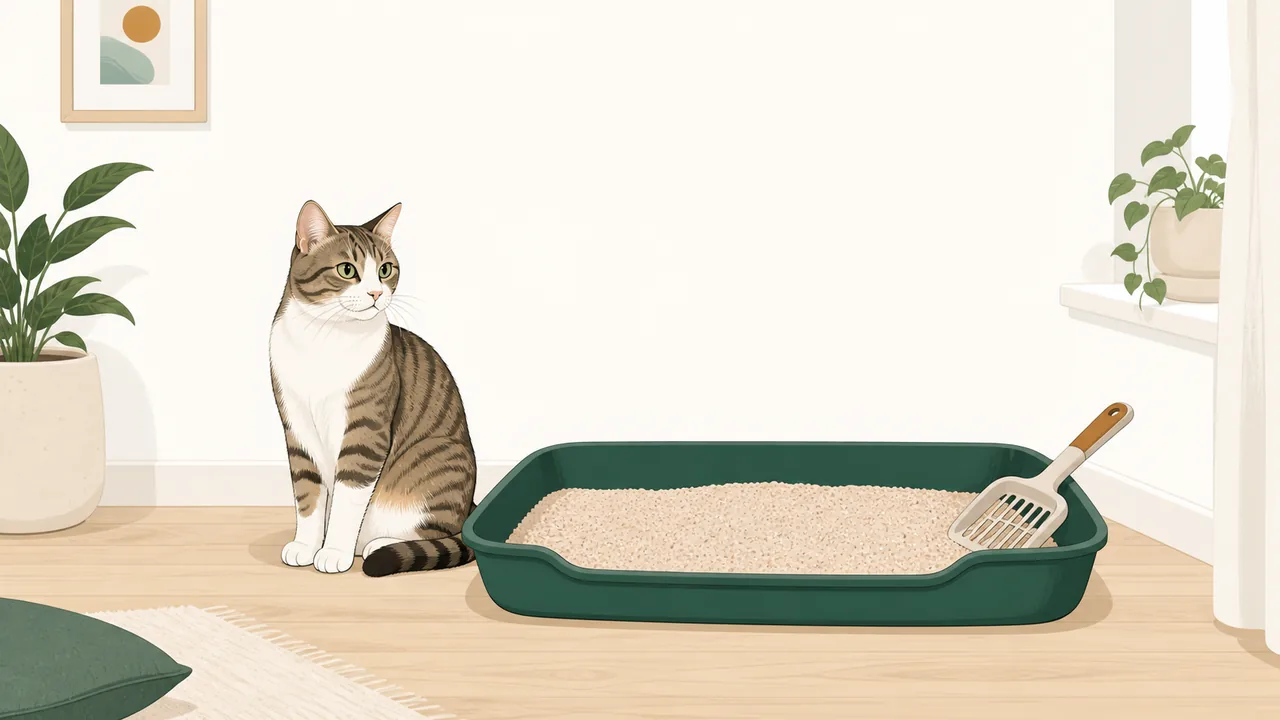
A litter box is the rare piece of cat gear where the cheapest sensible option is usually the best one, and the small-apartment shopper is the most likely to get talked out of it. Walk the aisle and the money is in covers, “corner” shapes that promise to disappear into a studio, and automatic boxes that rake themselves. Almost none of that addresses the criterion feline-care guidance keeps coming back to. So before comparing models, it’s worth fixing what you’re actually choosing for.
The job of a litter box is simple: a cat should want to use it, and you should be able to keep it clean without a fight. Everything that matters flows from those two things — size, how a cat gets in and out, how easy it is to scoop, and how many boxes you can realistically fit. Marketing mostly sells around the edges of that list. Here is the list itself, in the order that actually predicts success.
Size is the criterion that beats the label
Most boxes sold as apartment-friendly are too small, because “compact” sells in a small home. The AAHA and AAFP feline life-stage guidelines give a usable measuring rule instead of a guess: a box should be at least one and a half times the length of the cat, measured from the nose to the base of the tail. An average adult cat clears that only in the larger boxes, not the tidy corner trays. A box a cat has to fold itself into is one of the easiest setup mistakes to fix when an otherwise healthy cat starts going just outside it — though a cat that suddenly stops using a box it used before should see a vet, as below.
This is also where the cheapest trick in the guide lives. The ASPCA points out that a plain plastic sweater-storage container makes an excellent litter box — it is larger and far cheaper than most boxes marketed for the purpose. In a small apartment that one swap often solves the size problem and the budget problem at once, and you can cut a lower entry on one end if you need to.
Entry, sides, and the open-versus-covered question
After size, the next real decision is how the cat gets in and what happens to the litter that flies. High sides contain the spray from an enthusiastic digger; a low cut-out entry matters for kittens, seniors, and arthritic cats that can’t step over a tall wall. You are matching the box to the specific cat, not buying the most enclosed design on the shelf.
Covered, hooded boxes are where small-apartment buyers most often go wrong. The cover is sold to you — it hides the box and holds odor in — but holding odor in is not a feature from inside the box, and the ASPCA notes that most cats simply don’t care for lids. A hood also hides the mess, which quietly removes your daily reminder to scoop, and a box that doesn’t get scooped is the actual odor problem. None of this means a covered box can never work; it means the cover is a convenience for the human that some cats tolerate and some refuse, so it should be the thing you add cautiously, not the thing you start with.
The box types, compared
There is no single best box, only trade-offs against the criteria above. This is what each common type is genuinely good and bad at — based on the design and on feline-care guidance, not on testing any one product.
| Type | Works well for | Watch out for |
|---|---|---|
| Open pan (or storage tote) | Almost every cat; easiest to clean; cheapest; easy to size up | Litter scatter; no odor containment, so it relies on daily scooping |
| High-sided | Diggers and over-the-edge sprayers; still open on top | Tall walls are hard for kittens and senior cats — look for a low entry |
| Top-entry | Cutting scatter; deterring some dogs from the litter | Hard for less mobile cats; smaller usable floor than the footprint suggests |
| Covered / hooded | Owners who want it out of sight; cats that accept a cover | Many cats avoid it; traps odor inside; hides the mess so scooping slips |
| Automatic / self-cleaning | One adult cat, owner short on scooping time, larger budget | Expensive; can jam; the motor can scare skittish cats; size limits for kittens |
When the expensive box is the wrong buy
The self-cleaning box is the upsell most small-apartment shoppers consider and the one most can skip. It solves a real human problem — the daily scoop — but it adds cost, mechanical failure, and a moving mechanism that some cats won’t go near, and many units are sized for one adult cat rather than a kitten or a multi-cat household. The ASPCA’s own troubleshooting advice is telling: if a cat stops using a self-cleaning box, switch back to a plain one. If you are setting up for the first time, you simply don’t have the information yet to know your cat will accept the gadget, so the careful order is plain box first, automation only if a working routine makes you want it.
Two other “skip it” cases: a decorative corner box or furniture-style enclosure that fails the size rule is a worse box with a nicer exterior, and a covered box is the wrong starting point for a cat that already eliminates outside the box, since you’d be adding a barrier on top of an unsolved problem.
How many, and the small-apartment reality
The number is where apartments feel the squeeze. The long-standing guidance — one box per cat, plus one extra — isn’t arbitrary; the AAFP frames litter boxes as territorial resources, and in a one-cat home that still means two boxes, ideally not lined up side by side, since two boxes in the same spot read to a cat as one. In a small place that is genuinely hard, and it’s the constraint worth solving deliberately rather than ignoring: a second box in the bathroom or a closet often does it.
Placement follows the same logic as size — a box only counts if the cat will use it. Feline-care guidance favors quiet, accessible spots with a clear line of sight and an escape route, away from food and water and away from noisy machines like a washer that can switch on and startle a mid-business cat. The full placement question deserves its own treatment — see our guide on where to put a litter box in a small apartment — but the short version is that an oversized box in a bad corner still fails.
When it’s not the box — see a vet first
A cat that suddenly stops using a clean, correctly sized box may have a medical problem, not a preference one — urinary issues in particular can make elimination painful and urgent. The ASPCA is direct that the first step is to rule out medical causes and have a veterinarian examine the cat. No box upgrade fixes a health problem, so don’t keep buying gear to solve what may be a clinical issue.
Put the criteria back together and the recommendation is almost anticlimactic: for most cats in most small apartments, the box that works is a large, open, low-or-high-sided plain pan — or a storage tote standing in for one — with unscented clumping litter a couple of inches deep, scooped every day, and a second box you make room for somewhere quiet. That setup costs less than a single mid-range covered model and asks more of your routine than your wallet. The covered and automatic boxes solve human convenience, sometimes at the cat’s expense; they’re worth considering only after a plain setup is clearly working, and many homes never need them.
Working through a small-space setup more broadly? The same room-first logic applies to other gear — our guide on what size dog crate fits a small apartment and where to put it takes the measure-the-room-not-the-label approach for a different piece of equipment, and you can browse all our home-setup guides as the litter and feeding sections fill in.
Review basis. This is a research-based gear-selection guide drawing on ASPCA feline behavior guidance and the AAHA/AAFP 2021 Feline Life Stage Guidelines, applied to box design and dimensions. PawSetup did not test a specific product, invents no owner reviews or anecdotes, uses no affiliate links, and offers general setup information — not veterinary advice for your individual cat.