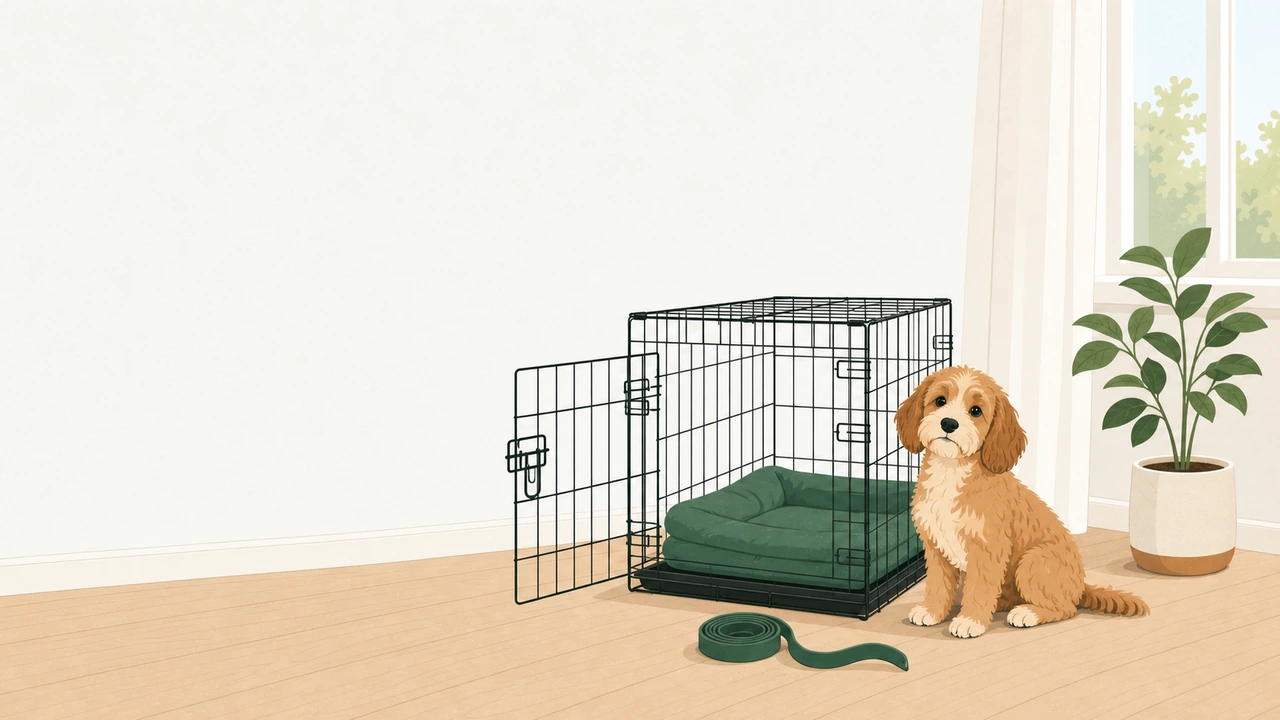
If you only remember one thing: pick the crate from your dog’s measurements and the floor space you can actually spare, then treat placement as half the job. A correctly sized crate in a bad spot still fails, and a great spot can’t rescue a crate the dog can barely turn around in.
Crate listings push a weight range because it is easy to print and easy to shop by. The problem is that two dogs at the same weight can be shaped completely differently — a long, low dog and a tall, compact one need different boxes. Measuring takes two minutes and removes the guesswork.
The measurement that actually sizes a crate
The American Kennel Club’s sizing method is simple enough to do with a soft tape and a treat to keep your dog standing still. Take two numbers:
- Height — from the top of the head down to the floor, with the dog standing.
- Length — from the tip of the nose to the tip of the tail.
Then add 3 to 4 inches to each number. That gives the interior height and length to look for. The standard the AKC sets is plain: the dog should be able to sit, stand, and lie down comfortably — and, in practice, turn around without folding into the walls. If you’d rather not do the arithmetic, our dog crate size finder takes those two measurements and returns the target dimensions and the standard crate size to look for.
Those interior numbers are the target, but in a tight room they aren’t the whole story. Before you commit, check the crate’s outside footprint and which way the door swings against the actual corner you have in mind. A few inches of exterior bulk, or a door that opens straight into a wall, is what turns a correctly sized crate into a daily annoyance.
Why bigger is not safer
It is tempting to size up “to be generous.” But the AKC notes that an overly spacious crate can actually backfire during house-training, because a dog can use one end as a bathroom and rest at the other. The goal is a snug den, not a spare room.
If you have a puppy, buy once
Sizing to a puppy means re-buying in a few months. The common fix is to buy the crate for the dog’s expected adult size and use a divider panel to shrink the usable space now, then move the panel out as the puppy grows. One purchase, no awkward in-between stage. If you are unsure of the adult size of a mixed-breed pup, that is a reasonable thing to ask your veterinarian about at a routine visit.
Crate types, and what each one is good at
“What size” and “what type” are different questions, and the right type depends on your floor, your dog, and whether the crate ever leaves the apartment. Here is the honest version of the trade-offs the AKC lays out.
| Type | Best for | Watch-outs |
|---|---|---|
| Wire / metal | Everyday home use; the sturdiest type, with good airflow and clear visibility; usually folds flat and takes a divider. | Can feel exposed in an open room — a light cover over part of it helps. |
| Plastic | Travel and car rides; durable and well ventilated, and this is the enclosed style typically used as an airline carrier. | More closed-in than an open wire crate — some dogs prefer the den feel, others like seeing the room. |
| Soft-sided / fabric | Small dogs and an economical option. | Harder to clean after an accident, and not the pick for a chewer. |
| Wood / furniture | Living rooms where the crate doubles as a side table; the most attractive option. | The priciest, and the hardest to move or fold away. |
For a small apartment with one fixed spot, a folding wire crate is usually the most forgiving starting point: it stores flat, it breathes, and the divider lets one purchase cover a growing dog. If the same crate has to fly or ride in a car often, a plastic travel-style carrier is the one to size carefully instead. Airline rules differ by carrier and route, so if flying is the goal, confirm your airline’s current cabin or cargo crate requirements before you buy.
Placement is the other half — and harder in one room
Where the crate goes changes how the dog feels about it. Animal-welfare guidance is consistent here, and it pulls in two directions you have to balance:
- Near the family. Dogs are social, and crate-training guidance from groups like the AKC keeps the crate in a room the household actually uses, so the dog feels included rather than shut away.
- Calm, not chaotic. The Humane Society’s crate-training guidance is to place it in a calm part of the home where the dog can relax without constant stimulation or noise, and to treat the crate as a safe zone the dog won’t be bothered in.
In a house those can be two different rooms. In a studio or one-bedroom, they are often the same eight square feet, so you are looking for the compromise corner: close enough to feel present, set back from the main walking lane, and out of the spots that get loud or hot — not jammed against a TV speaker or baking in afternoon sun. For overnight, the usual recommendation is to keep the sleeping crate in or near the bedroom, which a small layout actually makes easy.
Make the corner read as a den
A comfortable bed or soft blanket inside, the door left open when you are home so the dog can wander in on its own, and a partial cover over a wire crate all help the spot feel like a quiet retreat the dog chooses. Building that positive association is the whole point of crate training, and the AKC treats it as a gradual process that can run to about six months — plan for it over weeks and months, not a single weekend.
How long a dog should be in it
Sizing and placement only matter if the hours are reasonable. General welfare guidance puts rough ceilings on crate time: puppies under six months shouldn’t be crated more than three to four hours at a stretch, since they can’t hold their bladders longer, and adult dogs shouldn’t be left crated more than about four to five hours during the day. A crate is a short-term management and rest tool, not a place to park a dog through a full work shift.
When a crate is the wrong buy
Plenty of setups don’t need a crate at all, and a few shouldn’t use one as the answer:
- If your dog is already calm and reliable loose in the apartment, a crate may be solving a problem you don’t have. A bed and a gated area can be enough.
- A crate is not a fix for a dog that panics when left alone. Distress, frantic escape attempts, drooling, or injury around confinement point to something like separation anxiety, and forcing more crate time can make it worse. That is a conversation for your veterinarian or a qualified behavior professional, not a bigger lock.
- And the rule underneath all of it: a crate should never be used as punishment. The moment it becomes where a dog gets sent in anger, the calm-den association you were building is gone.
So the buying decision is smaller than the catalog makes it look. Measure your dog, add a few inches, pick the type that matches whether it stays put or travels, and spend the rest of your attention on the one corner it will live in. Get those right and the crate does its quiet job. Get the hours and the associations wrong and no size on the box will fix it.
Once the crate is chosen and in its corner, the next job is the routine that teaches your dog to like it. That’s the first-week crate training routine — a calm day-by-day pace for the introduction, the stretch to longer stays, and the first nights. In summer, double-check that the corner you picked stays out of the afternoon sun — the apartment heat setup guide covers that and the rest of a dog’s hot-weather setup. More pet home setup guides follow as the collection grows.
Review basis. This is a research-based selection and setup guide drawing on American Kennel Club and Humane Society guidance. PawSetup did not test a specific crate, did not collect product reviews for this guide, uses no affiliate links, and offers general information — not veterinary or behavioral advice for your individual dog.