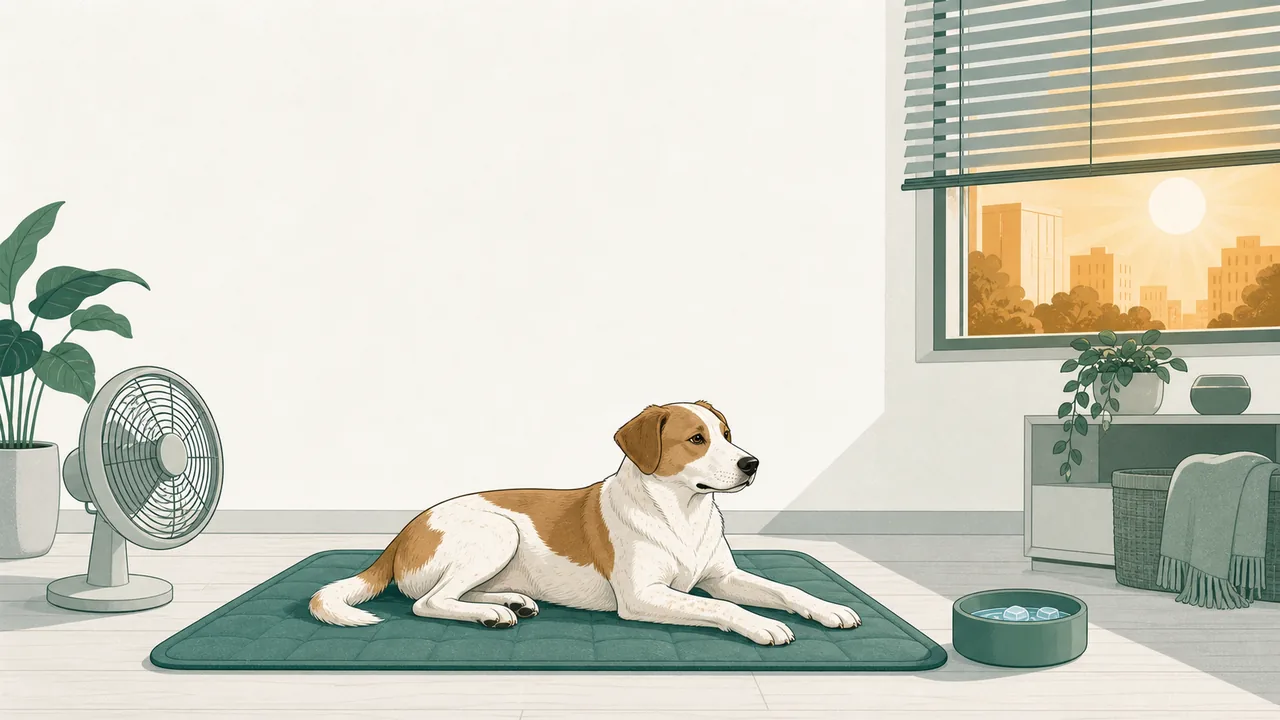
The risk to plan around is simple to state: a dog cools itself by panting, not by sweating the way a person does — and Humane World for Animals (formerly the Humane Society of the United States) warns that high humidity blunts panting, so a humid afternoon is harder on a dog than the thermometer suggests.
A small apartment gives a dog fewer ways out of the heat: no shaded yard, often no air conditioning, and no cool room except the one you set up on purpose. The good news is that almost everything that protects an apartment dog in summer is setup you can do in advance, and much of it costs little. This guide covers that setup; it is general information, not veterinary advice, and a dog already showing signs of overheating needs a veterinarian, not a checklist.
Start with one genuinely cool room
The American Veterinary Medical Association’s warm-weather guidance asks owners to provide “different temperature zones” within the home for a pet’s comfort. In a house that happens naturally; in a one-bedroom you have to build it. Pick the room or corner that never gets direct afternoon sun — often the bathroom or the north side — and make that the dog’s summer base. Close blinds or curtains on the sun-facing side before you leave in the morning — by the time you get home, the room has already spent its afternoon in the sun.
The fan in that room earns a caution of its own, because it is not the solution it feels like: Humane World notes that fans do not cool pets as effectively as they cool people, because dogs do not sweat the way we do. Moving warm air around a warm room helps a dog less than it helps you, so treat the fan as a supplement to shade and cooler floors. If you open windows for airflow instead, the ASPCA’s hot-weather guidance is to keep unscreened windows closed and make sure screens are tightly secured — apartment windows are exactly the ones pets fall from.
If your dog’s crate currently sits in a patch of afternoon sun, move it to the cool zone; placement rules for a small space are covered in the crate size and placement guide. For dogs with flat faces, the ASPCA goes further than shade: it recommends keeping flat-faced animals in air-conditioned rooms, because they are more susceptible to heat stroke. If your building has no AC and your dog is a pug, a boxer, or another short-muzzled breed, that is worth solving before July, not during the first heat wave.
Water in more places than you think you need
Both the AVMA and the ASPCA put fresh water at the top of their warm-weather lists — the ASPCA’s wording is that pets “can get dehydrated quickly” in hot or humid weather, and the AVMA asks for unlimited access to fresh water. In a small apartment the practical version is two bowls instead of one: the usual spot, plus one in the cool room, so a dog sheltering from the heat does not have to cross the warm side of the apartment to drink.
Humane World adds two cheap upgrades. Add ice to the water when you can, and treat ice cubes themselves as a fine warm-day offering for a dog to lick. It also suggests cooling mats or body wraps soaked in cool — not cold — water, which suit an apartment well: a soaked mat in the shaded corner gives the dog a cool surface to lie on even when the air is warm.
Move the walk to the edges of the day
The AVMA is direct about timing: do not walk, run, or hike with a dog during the hottest parts of the day. Humane World’s version is to limit exercise to early morning or evening hours on hot days. For an apartment dog whose entire bathroom routine happens on a leash, this is the habit that matters most — midday outings in July should be short, shaded, and functional.
The ground is half the problem. Asphalt holds heat long after the air cools, and the AVMA warns that hot surfaces can burn a dog’s paws; Humane World’s advice is to walk on grass where possible. The ASPCA adds the part that is easy to forget about small dogs especially: a dog’s whole body rides close to the pavement, so the same surface that warms your shoes radiates heat at the dog the entire walk. Keep moving — the ASPCA’s phrasing is not to let a dog “linger” on hot asphalt.
Watch the effort as well as the clock: the ASPCA cautions against over-exercising pets in heat, and the AVMA flags overweight dogs and short-nosed breeds as higher-risk for warm-weather exercise specifically, recommending a veterinarian’s input before starting an exercise program. A fetch session that is routine in April is a different proposition in a July heat wave.
The car rule has no exceptions
Every summer source repeats it because every summer it kills dogs: never leave a dog in a parked car. Humane World’s measured numbers make the case better than adjectives — on an 85-degree day, a car with the windows slightly open reaches 102 degrees inside in 10 minutes, and 120 degrees in 30, hot enough to cause irreversible organ damage or death. The AVMA closes the loopholes people reach for: not in the shade, not with the windows cracked, not for a quick errand. If you drive with your dog in summer, the errand stops being compatible with the dog; the car restraint guide covers the riding-safely half of that trip.
Trim, never shave — and skip your own sunscreen
A thick coat in July looks like a problem you should remove, and the ASPCA’s guidance is more specific: trimming longer hair is fine, but never shave a dog, because the coat’s layers protect against overheating and sunburn. Whether a particular dog would benefit from a warm-weather haircut is, per the AVMA, a question for your veterinarian rather than a default. If sun exposure is real — a balcony dog, a beach weekend — the ASPCA notes that any sunscreen used on a pet must be labeled specifically for animal use; products meant for people are not.
Dogs that need the strict version of this
The setup above is the baseline, and Humane World’s high-risk list names the dogs that need it tightened: very old and very young dogs, overweight dogs, dogs not conditioned to exercise, dogs with heart or respiratory disease, and short-muzzled breeds — it names boxers, pugs, and shih tzus — handle heat worse. The ASPCA’s parallel list repeats the theme: flat-faced animals, elderly pets, overweight pets, and pets with heart or lung conditions are more susceptible to heat stroke. If your dog is on either list, the cool room matters more, the midday walk shrinks further, and air conditioning stops being a luxury.
Know what an emergency looks like
No amount of setup removes the risk entirely, so the last piece of a summer setup is knowing when to stop troubleshooting. The AVMA’s list of signs that warrant emergency veterinary care: anxiousness, excessive panting, restlessness, excessive drooling, unsteadiness, abnormal gum or tongue color, or collapse. Humane World’s heatstroke list overlaps and extends it — glazed eyes, rapid heartbeat, lethargy, vomiting, a deep red or purple tongue, seizures, unconsciousness. The ASPCA adds that severe overheating can bring seizures, bloody diarrhea and vomiting, and a body temperature over 104 degrees.
If you see those signs, Humane World’s first-response steps are to move the dog into shade or air conditioning, apply cold towels or ice packs to the head, neck, and chest, offer small amounts of cool water or ice cubes — and go directly to a veterinarian. Note the modest verbs: this is what you do on the way to the vet, not instead of the vet. A dog showing heatstroke signs is having a medical emergency, and nothing in a setup guide treats it.
An apartment dog’s summer is mostly decided before the hot day arrives. The one purchase question worth settling early is air conditioning for a high-risk dog in a building without it; everything else here — the shaded room, the second water bowl, the earlier walk, the car rule — costs more attention than money. Which is exactly why it is worth doing this week, while it is still just weather.
More pet home setup guides follow as the collection grows.
Review basis. This is a research-based seasonal setup guide drawing on the American Veterinary Medical Association’s warm-weather pet safety guidance, the ASPCA’s hot-weather safety tips, and Humane World for Animals’ heat-safety resource. PawSetup did not test specific products, did not collect owner reviews for this guide, uses no affiliate links, and offers general information — not veterinary advice for your individual dog.