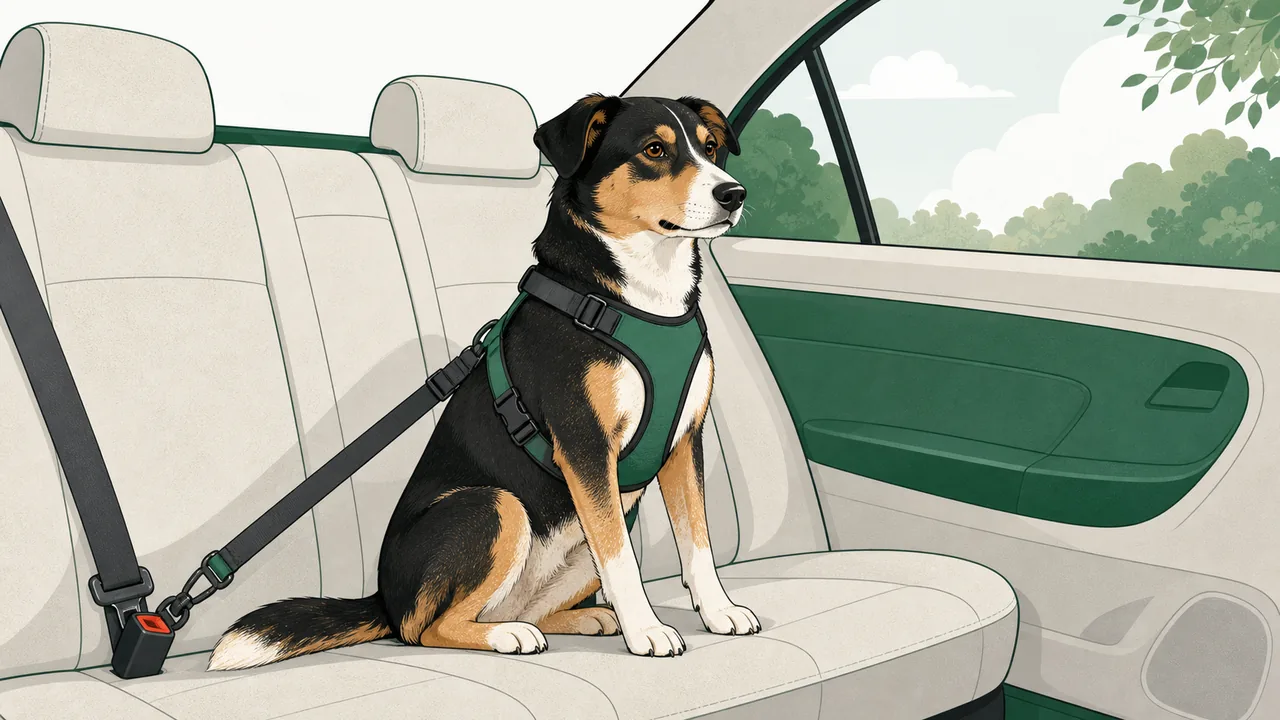
A dog riding loose in a moving car is the part of pet travel that owners notice last and that physics notices first. In a sudden stop or a crash, an unsecured dog keeps moving at the car’s speed — toward the windshield, the seat in front, or another passenger — and a startled, unsecured dog can also reach the driver’s feet at exactly the wrong moment. This guide is about the two restraint setups that are actually built and tested for that scenario, how to tell a real one from marketing, and where in the car it should go. It is general setup information, not veterinary advice; if your dog gets carsick, panics, or has a medical condition, talk to your veterinarian.
First, the claim to be skeptical of: “crash-tested”
“Crash-tested” on a box or harness sounds like a guarantee, and it usually is not one. As the Center for Pet Safety — an independent, non-profit research organization that does not take money from pet-product manufacturers — points out, a company can run a crate or harness through a test and advertise it as “crash-tested” without ever disclosing the standard used or whether the product actually passed. The phrase describes an event, not a result.
What you want instead is independent certification with a published result. CPS runs a certification program where manufacturers submit products to an independently developed safety standard; if a product fails, the maker has to fix it and resubmit before it can carry the certification. CPS also publishes its findings openly rather than behind a paywall, which is the part that makes the label mean something. So the practical filter is simple: look for CPS Certified, not “crash-tested.”
The two setups that pass: a certified crate or a certified harness
There are two restraint approaches with certified options for dogs, and which one fits depends on your dog and your car. (CPS also certifies some pet carriers, which matter more for cats and small dogs than for a full-size dog; if that is what you are transporting, the companion guide to choosing a cat carrier covers that case.)
A crash-test-certified travel crate is the sturdier option, and a good fit if your dog already rides calmly in a crate at home — often the same crate you sized for your space in our dog-crate guide — or you have the cargo room. On the CPS certified list you will find crates such as the Gunner G1 (in small, medium, and intermediate sizes), the Cabela’s GunDog kennel (intermediate and large), and the Lucky Duck kennel (medium, large, and intermediate). These are rigid, anchored enclosures — closer to a roll cage than a soft den.
A crash-test-certified harness is the lighter, more compact option, and often the realistic one for a small apartment and a small car where a hard crate will not fit. The harness that has carried CPS certification in this category is the Sleepypod Clickit line (the Sport and Terrain models); these connect to the car’s seat-belt system rather than just clipping to any leash. A plain walking harness with a seat-belt clip is not the same thing and is not built to hold up in a crash.
Notice what is not on the certified list: the stretchy “seat-belt tether” attachments often sold at the register. They keep a dog from wandering the cabin, which has real day-to-day value, but that is not the same as crash protection.
Where it goes in the car, and how to set it up
Picking a certified product is half the job; installing it correctly is the other half, and this is where the free advice from the American Veterinary Medical Association is worth following to the letter.
- Keep the dog out of the front passenger seat if your car has airbags. A deploying airbag is built for an adult human, not a dog, and the AVMA specifically advises against dogs riding up front where airbags are present. The back seat or a secured cargo area is the place.
- Never let the dog ride on the driver’s lap, and do not let a dog ride with its head out the window — the AVMA notes that airborne debris can injure a dog’s eyes, ears, nose, and mouth at speed.
- Anchor the crate so it cannot move. A heavy crate that is itself loose in the back becomes its own projectile. Secure it per the maker’s instructions so it stays put.
- Route a harness through the actual seat-belt path, sized snugly enough that your dog can sit and lie down but not be thrown forward. A harness that is too loose defeats the point.
- Never leave your dog unattended in a parked car. This is a temperature-and-theft rule, not a restraint one, but it belongs in any car-travel routine — the summer heat setup guide has the parked-car temperature numbers and the rest of a dog’s hot-weather routine.
One more setup step has nothing to do with the crash and everything to do with whether your dog tolerates the trip: get the dog used to the crate or harness, and to the car itself, before a long drive. The AVMA recommends building that familiarity in advance rather than introducing restraint and travel at the same stressful moment.
The quick filter
Buy for the words CPS Certified, not “crash-tested.” Put the dog in the back, never the airbag seat or the driver’s lap. Anchor a crate or belt a harness so it cannot move. Practice with both the restraint and the car before the first real trip.
When the expensive option is the wrong buy
You do not automatically need the top-of-the-line crate. If your dog only travels a few times a year for vet visits and rides better contained, a correctly sized, secured certified carrier or a certified harness can be the more sensible setup than a large kennel you cannot fit in the car or store in a one-bedroom apartment. Match the restraint to your actual trips: a daily commuter dog, a road-trip dog, and a twice-a-year vet visitor are different problems, and a full travel crate makes the most sense for the dog that rides often rather than the one that travels twice a year.
The honest version of car safety for pets is unglamorous. Buy for the certification and the fit, put the dog in the back, anchor or belt the restraint the way the manufacturer says, and practice before you need it. A dog that is secured in a crash is one that is not loose in the cabin — and if you are ever unsure whether your dog is healthy enough to travel, or how to handle motion sickness or travel anxiety, that question is for your veterinarian, not a product page.
Review basis. This is a research-based safety guide drawing on Center for Pet Safety crash-test certification and AVMA pet-travel guidance. PawSetup did not hands-on test products or invent owner reviews, uses no affiliate links, names products only because they appear on the public CPS Certified list, and offers general setup information — not veterinary advice for your individual pet.