Two dogs at the same weight can need different crates — a long, low dog and a tall, compact one don’t fit the same box. That’s why a weight chart alone gets people the wrong crate. This tool uses the measurement method instead: measure your dog, add a few inches, and it tells you the interior size to target and the standard crate that matches.
Picks typical adult measurements you can adjust. Breeds vary — measure your own dog to confirm.
Your result
Enter your dog’s measurements and the suggested crate size will appear here.
This tool runs entirely in your browser. No measurements are sent anywhere, saved, or tracked.
How this tool sizes a crate
It applies the American Kennel Club’s sizing method, the same one in our crate size and placement guide. You take two measurements with the dog standing — length from nose to tail tip, and height from the top of the head to the floor — and add 3 to 4 inches to each for room to sit, stand, turn around, and lie down. This tool uses the 4-inch end of that range as the target, then rounds up to the smallest size crates are actually sold in that still meets it — so the recommended crate clears your dog without oversizing. For a dog bigger than the largest common crate, it says so and points you to a giant or custom size.
Why bigger isn’t better
It’s tempting to size up to be generous, but the AKC notes an oversized crate can backfire during house-training: a dog can use one end as a bathroom and rest at the other. Aim for a snug den, not a spare room — which is why this tool picks the smallest standard size that still clears your dog by the AKC’s 3–4 inches, instead of pushing you to an oversized crate.
Standard crate sizes, and what they roughly fit
Most wire crates are sold in a handful of common lengths. The tool maps your target to this set; the table is here so the page still answers the question without the calculator. Treat the example dogs as a rough guide only — confirm with your own measurements and the crate’s listed interior dimensions.
| Crate length | Common size name | Often suits (verify by measuring) |
|---|---|---|
| 18–22 in | Extra small | Toy breeds — Chihuahua, small terrier puppies |
| 24 in | Small | Small dogs — Pug, Frenchie, Shih Tzu |
| 30 in | Medium | Mid-size dogs — Beagle, Corgi, Cocker Spaniel |
| 36 in | Large | Larger dogs — Brittany, Staffordshire Bull Terrier |
| 42 in | Extra large | Big dogs — Labrador, Border Collie, Husky, Boxer |
| 48 in | 2X large | Very large dogs — German Shepherd, Rottweiler |
| 54 in | Giant | Giant breeds — Great Dane, Mastiff |
What the four crate types look like
The tool recommends a type as well as a size, because shape changes how a crate fits a room and a routine. Here is roughly what each one looks like, left to right.
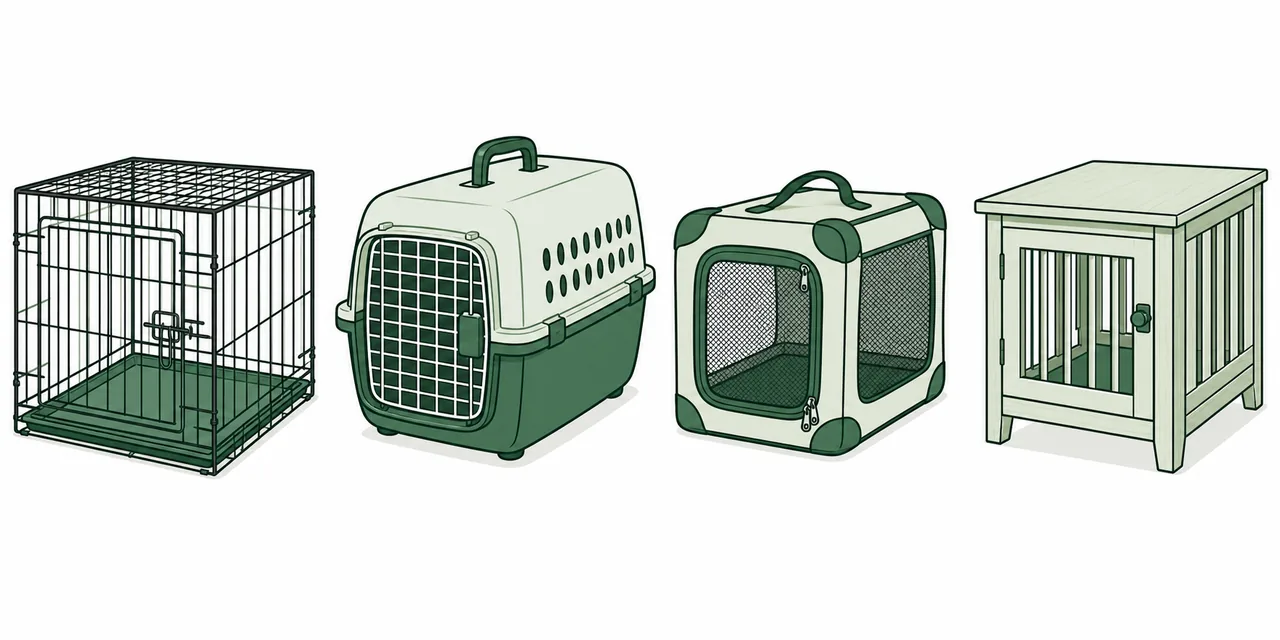
Original generated illustration — for explanation only, not a specific product. Type strengths and trade-offs follow AKC crate guidance.
After the tool gives you a number
The size is the start of the decision, not the end. Three things the calculator can’t see:
- Check the interior, not just the label. Two “36-inch” crates can have different usable interiors and door swings. Compare the listed inside dimensions to your target numbers.
- Match the type to how it’s used. For a fixed spot at home, a folding wire crate with a divider is forgiving. If it travels often, a plastic carrier sized carefully is the one to look at — and airline rules differ by carrier and route, so confirm current requirements before flying.
- Buy a puppy’s crate for the adult size. Get the adult-size crate and use a divider to shrink the space now, so you buy once. Unsure of a mixed-breed puppy’s adult size? That’s a fair question for your vet at a routine visit.
One thing a size finder can’t fix
A crate is not the answer to a dog that panics when left alone. Frantic escape attempts, drooling, or injury around confinement point to something like separation anxiety, and more crate time can make it worse — that’s a conversation for your veterinarian or a qualified behavior professional, not a different box. And a crate should never be used as punishment.
Once you’ve picked the crate, the next job is the routine that teaches your dog to like it. That’s the first-week crate training routine. For the full picture on choosing a type and where to place it in a small home, read the crate size and placement guide, or browse all pet home setup guides.
Method basis. This tool applies sizing and crate-type guidance from the American Kennel Club and crate-use guidance from the Humane Society. The standard crate lengths and size names reflect what wire crates are commonly sold as; the breed presets and example breeds are typical adult estimates to start from, not exact figures, and must be confirmed by measuring your own dog. PawSetup did not test a specific crate, uses no affiliate links, and offers general information — not veterinary or behavioral advice for your individual dog.