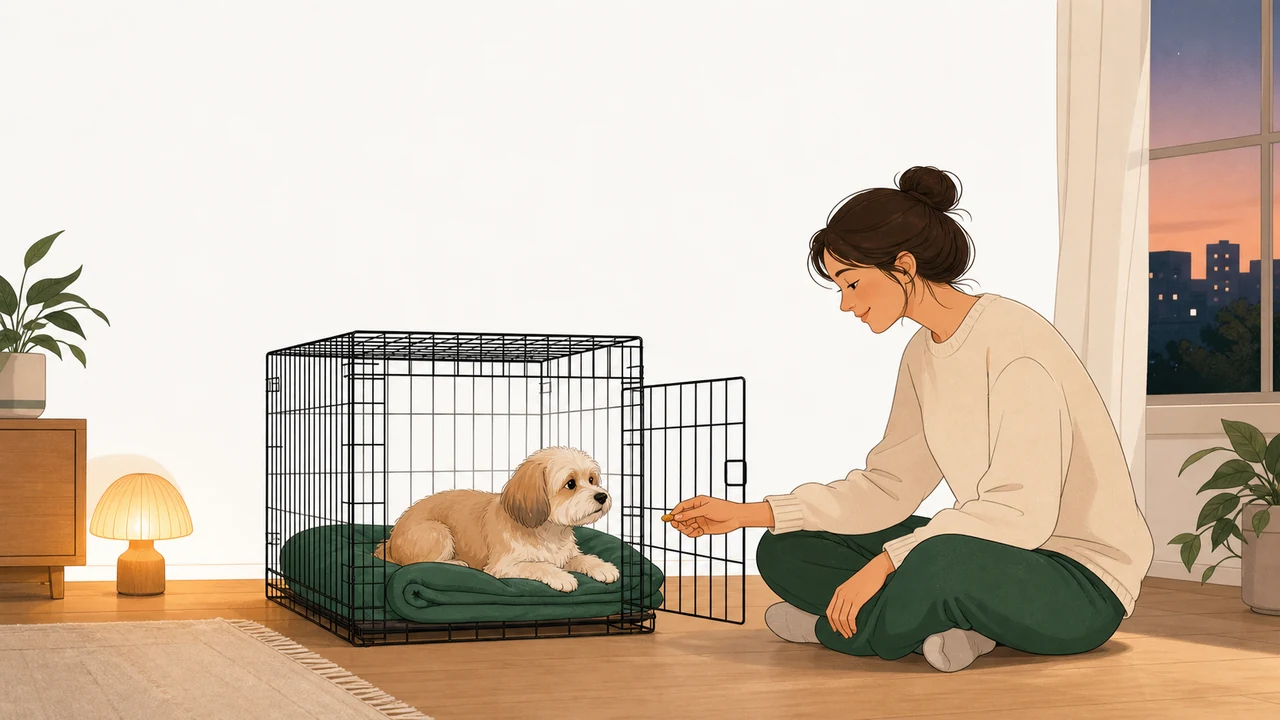
You just brought a dog home, and crate training is often pitched as a quick job — a few days and you’re done. It rarely works that way; the AKC describes the full process as taking around six months. The first week isn’t about getting your dog to stay crated for hours. It’s about making the crate calm, safe, and a little bit rewarding, so the longer training has something to build on.
So treat week one as foundation, not a finish line. Below is a realistic pace drawn from AKC and Humane Society crate-training guidance. Adjust it to the dog in front of you: a confident adult rescue and an eight-week-old puppy move at very different speeds. An adult dog with an unknown past often needs the slow version — shorter sessions, more days spent on the early steps, and extra patience if the crate seems to remind them of something bad — while a young puppy is mostly limited by its bladder and its short attention span.
Before day one: get the setup right
A bad first week is often really a setup problem. Before any training starts, make sure the crate is the right size and in the right spot, because a crate that’s too big, too cramped, or parked somewhere stressful — wedged beside a loud TV, in a busy doorway, or in a corner that bakes in afternoon sun — will undercut everything you do next. If you haven’t chosen it yet, our guide on what size crate to buy and where to put it covers the measuring and placement first.
Two setup rules matter from the very first minute:
- Comfortable and calm. Soft bedding inside, and a calm corner of a room the household actually uses — close enough that the dog feels included, set back from the noisiest traffic.
- Collar off, every time. The AKC is blunt about this: a dog should never wear a collar or tags inside the crate, because they can catch and strangle. Take it off before the door closes.
Days 1–2: make the crate pay
The goal of the first couple of days is simple: your dog walks past the open crate and thinks something good might happen in there. Introduce it when the dog is calm, not mid-zoomies, and never push them in.
- Prop the door open and toss a few treats inside so they go in and out on their own.
- Start feeding meals in or right next to the crate, so it becomes the place dinner happens.
- Once they’ll settle inside, close the door for a minute or two while you sit nearby, then open it before they get anxious. Build from there — the AKC suggests starting around ten minutes and working up.
- A frozen chew or a rubber toy stuffed with a little dog-safe, xylitol-free peanut butter turns crate time into something the dog looks forward to. Pick a toy sized for your dog, avoid anything small enough to swallow or easy to shred apart, and supervise a new chew the first few times.
Keep the door open whenever you’re home so the crate stays a place they can choose, not only a place they get shut into.
Days 3–5: stretch the time in small steps
Now you start leaving the room, then leaving the apartment — in increments that would feel almost comically small if you didn’t know how easily this goes wrong. The classic error is going from “five minutes” to “a full workday” because day two went well.
The AKC’s own framing is to start with something like stepping out for a cup of coffee and coming back, not heading out to dinner for six hours. Lengthen the absences gradually, and keep your comings and goings low-key: a calm exit and a matter-of-fact return teach the dog that nothing dramatic happens around the crate.
The time ceilings that don’t move
No matter how well the week is going, two limits hold: a puppy under six months shouldn’t be crated more than three to four hours at a stretch, because they physically can’t hold it longer, and an adult dog shouldn’t be crated more than about four to five hours during the day. The crate is a short-term tool, not a place to park a dog through a full shift.
The first nights
Night one is usually the hardest, and it helps to expect that. A puppy who cries the first night or two is normal — they’re adjusting to a home without their mother and littermates, not staging a protest.
A few things make those nights easier:
- Crate in or near your bedroom. Being close reassures the dog and lets you hear a genuine I-need-to-go whine.
- Last potty break right before bed. Dogs hold longer while asleep, so end the night empty.
- Know the bladder math. A useful rule of thumb for puppies: they can hold roughly their age in months plus one, in hours. A three-month-old maxing out around four hours overnight is normal, and most puppies can sleep through the night by about four months — though plenty take a little longer, and a four-month-old who still wakes once isn’t a failure.
- Preempt, don’t reward attention-barking. First rule out a real need — a puppy who has to go out should be taken out. The trick is timing: if your puppy can’t yet last the night, set an alarm and take them out before the whining starts, on a quiet, boring trip with no play, so a needed potty break never doubles as a reward for barking. Routine fussing that settles within a few minutes is normal; crying that escalates toward the panic described further down is a different problem and should not be waited out.
What not to do in week one
- Never use the crate as punishment. If it becomes where the dog gets sent in anger, the calm association you’re building is gone — and you’ll be fighting that for weeks.
- Don’t leave anything around the neck. Collar and tags off, every single time the door closes.
- Don’t treat a good morning as permission to skip ahead. Crate training isn’t linear; the AKC describes the whole process as taking around six months, with good days and bad. Week one is the start of that, not a shortcut around it.
When it’s not working — and when to get help
Most first-week wobbles are pace problems: back up a step, shorten the times, and rebuild the good association. But some signs are not a training-pace issue and shouldn’t be pushed through.
If your dog panics in the crate — frantic escape attempts, drooling, injuring itself, soiling out of distress, or relentless barking that doesn’t settle as you build up slowly — that can point to something like separation anxiety, and more crate time tends to make it worse, not better. A crate does not treat that. The right next step is a conversation with your veterinarian or a qualified behavior professional who can look at your specific dog.
By the end of a good first week, the goal is modest: a dog who will walk into the crate on their own, settle for a short stretch, and sleep through most of the night. That is the foundation the longer training builds on — nothing dramatic, just a dog who has decided the crate is a fine place to be. Some dogs get there faster, some slower, and a few need the help described above.
Still setting up? Start with the gear decision in our crate sizing and placement guide, then come back to this routine once the crate is in its corner.
Review basis. This is a research-based setup and routine guide drawing on American Kennel Club and Humane Society crate-training guidance. PawSetup did not train a specific dog, invents no owner anecdotes, uses no affiliate links, and offers general information — not behavioral or veterinary advice for your individual dog.